
For a US automotive manufacturer that depends on more than 200 active vendors, the steady stream of supplier files coming into its environment had turned into both a security exposure and a rising operational cost. The strain is felt acutely across manufacturing, an industry where SOC teams shoulder a workload that runs, on average, 18% higher than security teams in other sectors.
A Manufacturer Built on a Sprawling Supplier Network
The organization is a US-based automotive manufacturer that sits inside a deeply interconnected supply chain. Its day-to-day production relies on constant collaboration with more than 200 active vendors and third-party contractors.
These partners send files into the company on a routine basis to keep manufacturing, technical, and business workflows running. That exchange is what keeps operations moving — but it also opens a wide and ever-shifting doorway for risk.
The SOC’s job is to defend the company’s environment while making sure genuine supplier activity isn’t held up. As inbound file volume climbed, the team needed a reliable way to review every submission to the same standard, speed up detection and response, and shrink third-party exposure without growing payroll.
The Problem: Supplier Files Arrived With No Consistent Way to Vet Them

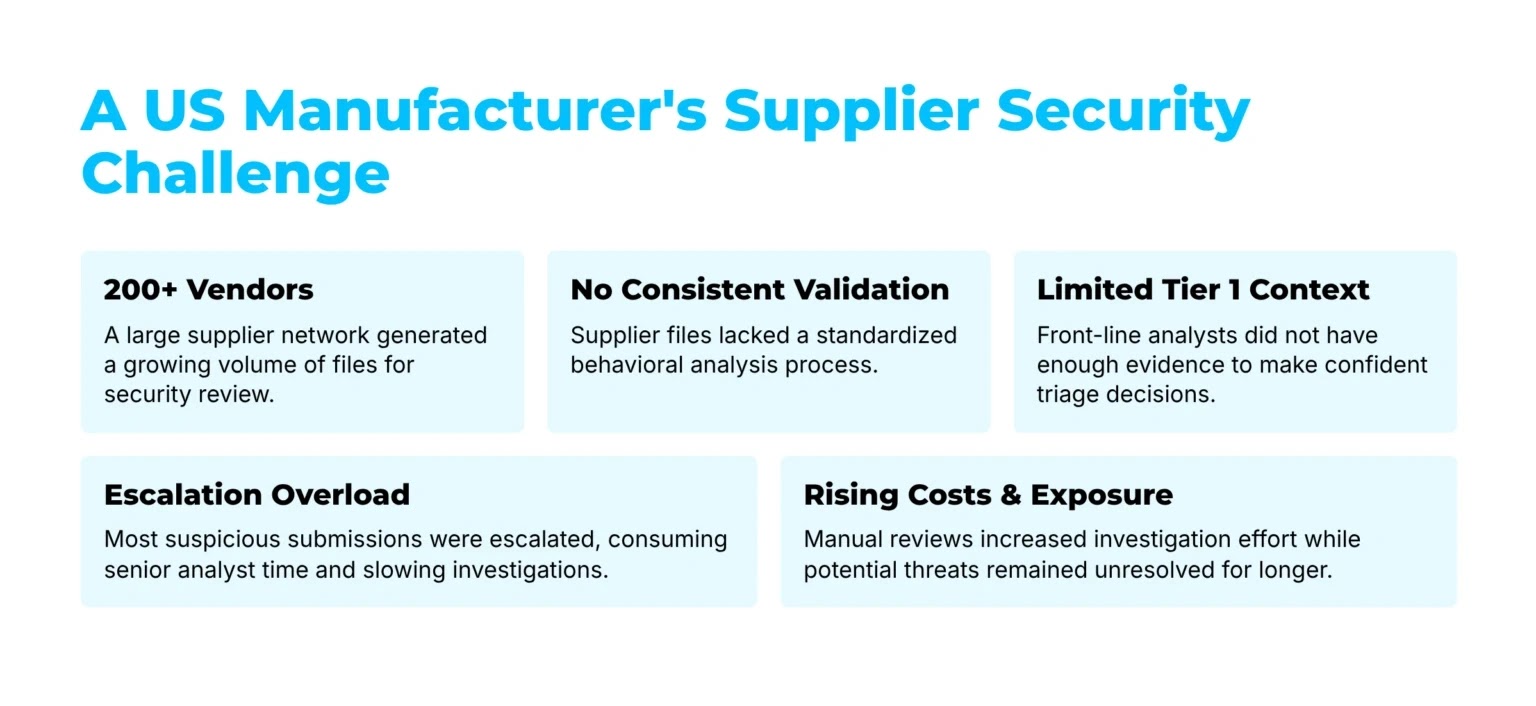
Its existing controls could mark a file as suspicious, but they often couldn’t reveal what that file would actually do once it ran. Lacking behavioral evidence, analysts were stuck with partial indicators and shaky verdicts.
That gap produced several recurring issues for the SOC.
An Inspection Blind Spot in File Intake
Files could enter the environment without ever passing through a dedicated behavioral analysis stage.
This left the company unable to spot threats that looked benign under static inspection but only showed their malicious side after execution.
In a supplier ecosystem this large, the danger was magnified. A single compromised vendor account or mailbox could quietly convert a trusted line of communication into an indirect path into the company. Given that more than 47% of attacks against manufacturers begin with email, supplier messages and attachments made up a critical slice of the third-party attack surface.
Too Many Escalations
Tier 1 analysts frequently didn’t have the evidence to close out suspicious submissions on their own.
So most of those files were pushed up to more experienced staff. Senior analysts ended up spending their time on cases that clearer evidence could have settled far earlier.
Climbing Investigation Costs
The vendor network kept producing files at a steady clip. Keeping up through manual review alone would have meant more analyst hours and, before long, more hires.
Without a process that could scale, the company faced paying more simply to hold its protection at the same level.
That squeeze is particularly tough in manufacturing, where SOC teams already carry a workload roughly 18% higher than security teams elsewhere. For any organization juggling a big supplier base, manual investigation becomes harder and harder to sustain.
Longer Windows of Exposure
Every hour spent validating a suspicious file stretched out the period when the company couldn’t confidently clear it, block it, or contain it.
In a manufacturing setting, a threat that slips through reaches well beyond a single endpoint. It can halt operations, expose sensitive information, and erode trust across the entire supplier network.
Building a Scalable Triage Process With ANY.RUN
The manufacturer put in place a uniform workflow for analyzing files received from vendors and contractors.
Pairing behavioral analysis with threat intelligence gave the SOC two things at once: hard evidence of what a file does, and the surrounding context to gauge the larger threat behind it.
Rather than leaning on isolated alerts or half-complete indicators, analysts could now flag malicious submissions with greater accuracy, arrive at verdicts sooner, resolve more cases at Tier 1, and free senior analysts from routine reviews.
The net effect was better detection quality alongside lower MTTD and MTTR on supplier-related cases.
Faster Verdicts Backed by Behavioral Evidence
Triage time dropped once analysts could directly observe what suspicious supplier files did after running.
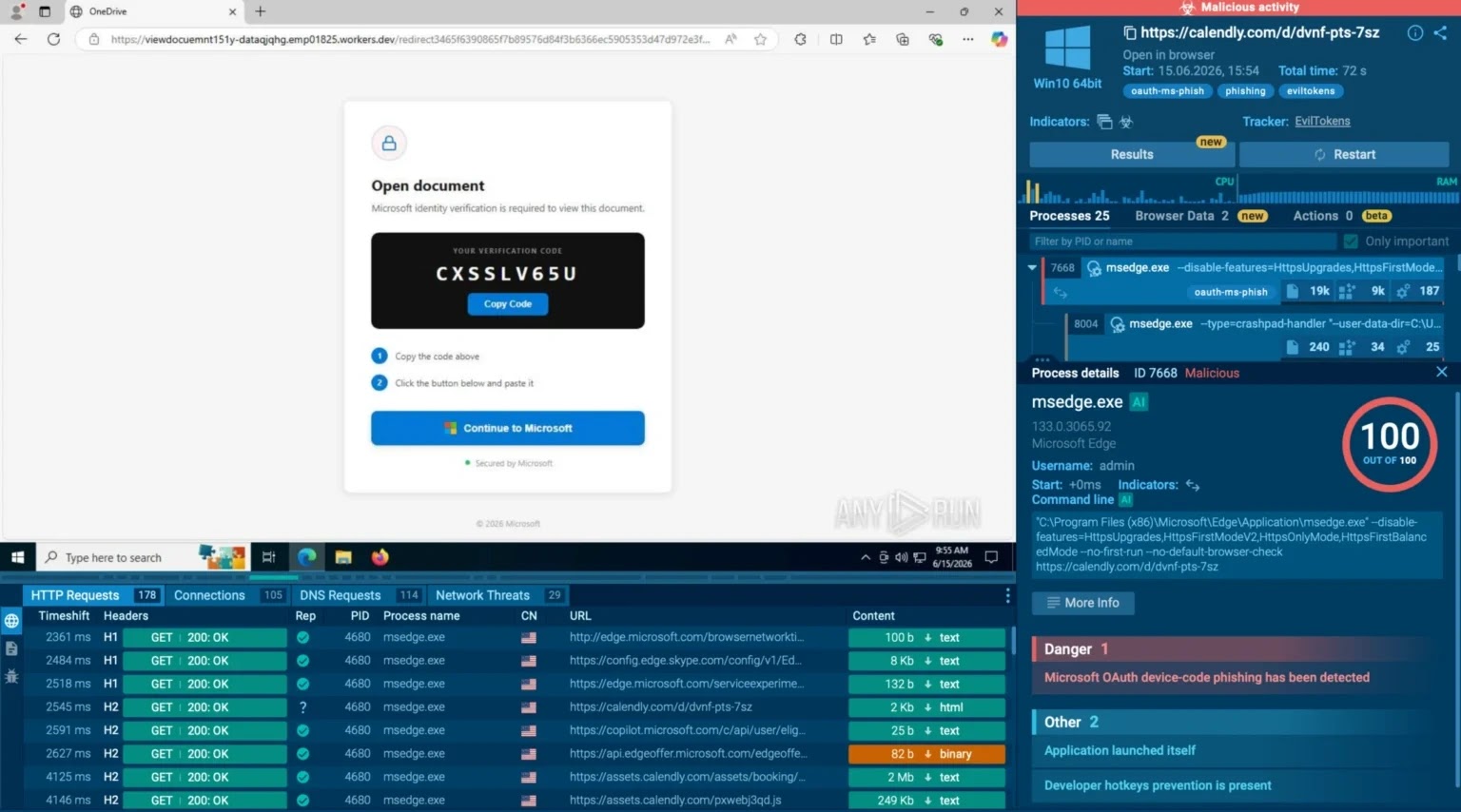
Incomplete indicators gave way to clear proof of whether a submission was malicious and how it might hit the business.
Structured, visual output also moved Tier 1 analysts from alert to verdict with far fewer manual steps. Instead of stitching file behavior together across disconnected tools, they could validate suspicious submissions quickly and decide with confidence.
That shorter route from alert to confirmed verdict pushed MTTD down, while cleaner evidence and fewer repeat checks helped bring MTTR down too.
Cut investigation time with clear behavioral evidence
Help analysts reach faster decisions.
Accelerate triage now
Linking Supplier Files to Broader Threat Activity
Indicators surfaced during analysis could be matched against malicious infrastructure, related samples, known campaigns, and ongoing attacker activity. That told analysts whether they were looking at a one-off file or a wider operation aimed at the company’s supplier ecosystem.
The SOC also used that context to dig out additional indicators and behavioral patterns, reinforcing its internal detection controls beyond the original file.
As a result, every investigation fed into a wider picture of the threat landscape. The team could close the immediate case while simultaneously spotting related activity that might otherwise have stayed hidden across the supply chain.
Closing More Cases at Tier 1
Previously, suspicious supplier files routinely climbed the escalation ladder because Tier 1 analysts lacked the evidence to call them safe or malicious with confidence.
Now, with behavioral analysis, threat intelligence, and structured Tier 1 Reports all sitting in one workflow, first-line analysts get a clear summary of each case plus concrete recommendations for the next step.
That cut down the need to manually interpret every technical detail and let analysts decide faster. The company logged a sharp drop in Tier 1 escalations, and Tier 2 stopped receiving as many low-context cases.
The shift trimmed duplicated effort and put specialist expertise to better use. Senior analysts spent less time repeating basic validation and more time on complex, high-impact threats.
More files were handled at the right tier the first time around, which kept investigation queues moving and lowered the cost of each case.
Handling Hundreds of Files Without New Hires
The company now reviews hundreds of supplier files every week without bringing on extra analysts.
For the business, that’s one of the most tangible payoffs of the new process. The manufacturer scaled up its triage and analysis capacity while holding staffing costs flat.
Instead of treating more headcount as the only answer to rising file volumes, the company handed its existing team a quicker, more consistent way to catch malicious activity and reach verdicts.
The SOC now absorbs more supplier traffic without a matching jump in labor costs or investigation backlogs.
It also gives the company a more sustainable footing for growth. As the vendor network grows or file volumes rise, the security team has a triage process that scales right along with it.
Reduce third-party exposure before it affects operations.
Increase security capacity without increasing headcount.
Reduce risk now
Better MTTD and MTTR Through 2x Faster Triage
The manufacturer achieved a 2x improvement in alert processing and threat analysis speed, feeding directly into lower mean time to detect and mean time to respond.
Suspicious supplier files now move through triage twice as fast. Analysts identify malicious behavior earlier, confirm verdicts with less delay, and pass high-risk cases into response with the evidence already gathered.
Legitimate submissions clear faster too, so business teams spend less time waiting on a security decision.
The quicker workflow also shrank the company’s exposure window. Analysts reached evidence-backed verdicts sooner without trading away investigation depth — protecting operations while keeping supplier workflows on the move.
A Workable Blueprint for Manufacturing Leaders Facing Third-Party Risk
For manufacturing executives, supplier security reaches well past the SOC. It touches operational continuity, staffing budgets, executive accountability, and the company’s ability to grow without piling on exposure.
A scalable answer has to bring together consistent file validation, broader threat context, and measurable results.
Make File Intake a Defined Risk Control
A consistent triage process lets the SOC apply the same yardstick to every file from vendors and contractors.
For leadership, that brings clearer oversight of one of the company’s most exposed third-party channels.
Grow Capacity Without Matching It With Headcount
Faster verdicts and fewer needless escalations let the current team take on more supplier submissions.
The payoff is lower investigation cost and more value out of the security resources already in place.
Defend Operations Without Slowing Suppliers Down
Suspicious files can be analyzed in a controlled environment before they ever reach internal systems, while legitimate submissions clear review faster.
That lowers the risk of supplier-borne threats without introducing needless delays for manufacturing, procurement, engineering, or any other team that relies on third-party collaboration.
Tie Single Submissions to Wider Exposure
A suspicious file may be just one piece of a larger campaign.
That gives leadership a sharper view of whether the company is dealing with a lone file or a wider exposure spanning suppliers and other outside partners.
Show Measurable Business Value
The strongest supplier security programs are judged by outcomes, not by how many files get processed.
Those results make it far easier to demonstrate how supplier security spending cuts risk, avoids extra staffing costs, and supports business growth.
Reduce supplier-driven risk before it affects operations.
Conclusion
For this US automotive manufacturer, supplier file intake had become both a security liability and a growing cost center. More than 200 vendors were funneling files into the environment, and analysts had no consistent way to validate behavior, layer in threat context, and reach quick decisions.
The outcome is a sturdier security model for a complex supplier ecosystem: less third-party exposure, smarter use of analyst time, and faster decisions that keep the business running.