Nine out of ten cyber attacks start with phishing. When an incident occurs, it’s often a person who’s held accountable: a compromised employee or a SOC analyst who missed a signal.
But in a corporate environment, this framing doesn’t always apply. If a single human mistake puts the entire company at stake, the real issue might be the lack of a specific phishing defense layer.
Its presence significantly lowers the odds of a breach happening and reduces the dependency on human judgment alone.
Here’s what CISOs can improve inside the SOC to reduce phishing risk.
Commonly Exploited Visibility Gap
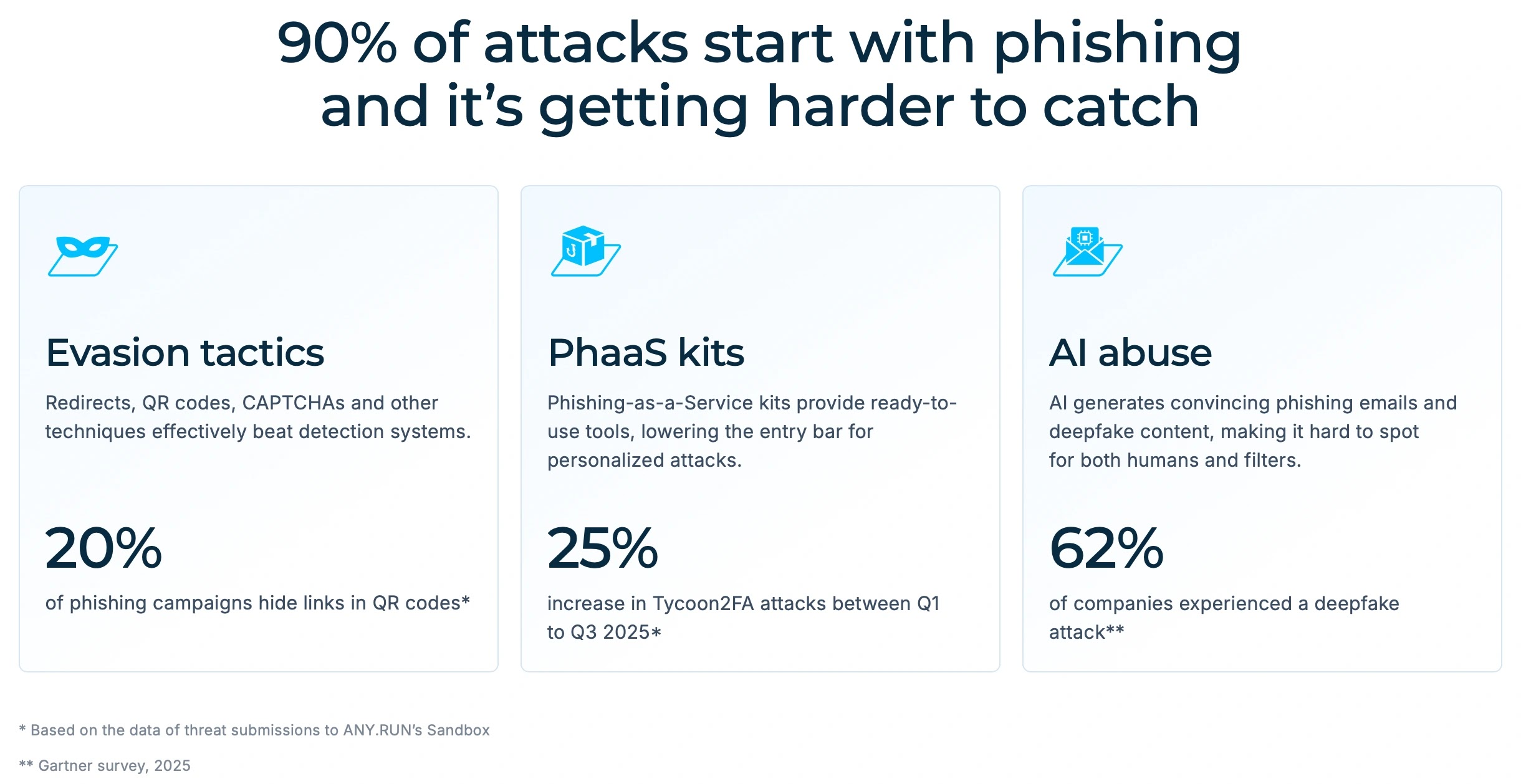
Modern phishing threats are built to create uncertainty. They aggregate QR codes, redirects, CAPTCHAs, and AI-generated content to make quick alert verification increasingly more difficult.
These methods allow them to conceal the intent behind their campaigns. Is it credential theft, infrastructure intrusion, malware delivery, or something else? Was it even an attack in the first place or just a benign anomaly?
Meanwhile, the trends signal the increasing danger of advanced phishing attacks:
- 20% of phishing campaigns hide links in QR codes
- Tycoon2FA attacks increased by 25% between Q1 and Q3 2025
- According to Gartner, 62% of companies experienced a deepfake attack in 2025
Phishing becomes more adaptive, more evasive, and more difficult to investigate quickly.
The lack of certainty and visibility creates a dangerous gap in SOC investigation workflow that puts the entire infrastructure at risk:
- Triage cycles extend
- Analyst confidence in decisions declines
- Escalation volume increases
- Response gets delayed when speed matters most
This results in a gap that attackers actively exploit.
Solution #1: Restoring Full Attack Chain Visibility
A triggered alert alone is not enough. To understand the intent behind it, see where the attack flow leads, and learn what the user is pushed to do, analysts need to close the visibility gap.
A fast and simple way to do that is interactive analysis. It’s a reliable, and easy way to achieve full chain attack visibility in mere minutes.
Without that, teams spend extra time validating the threat, confidence in verdicts drops, and more cases are escalated than necessary.
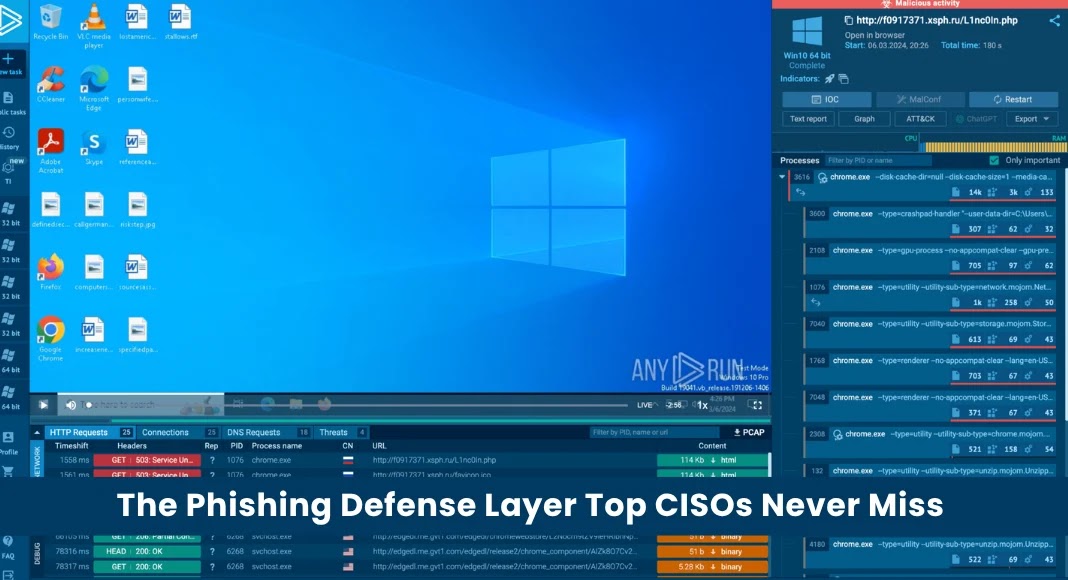
Within its flexible VM supporting major OSs like Windows, macOS, Linux, and Android, analysts can see exactly how the threat would behave during a real attack with full context and behavioral insights.
Some of the Interactive Sandbox use cases for phishing protection:
- Analysis of files and URLs to spot phishing early with average 15 sec MTTD
- Inspection of redirects in real time and open attachments and observe threat behavior
- Unraveling what’s hidden behind QR codes and CAPTCHA-protected flows
This eliminates guesswork and leaves no space for uncertainty. Analysts validate threats and investigate suspicious behavior in minutes, gaining all the context needed for further escalation.
Automated Interactivity functionality extends this further by simulating analyst behavior. It can:
- Automatically interact with phishing pages
- Scale the volume of analysis and reduce manual effort
- Traverse redirect chains
- Bypass CAPTCHA barriers
- Reveal hidden stages without delay
This helps teams move through evasive phishing stages faster and reach the real malicious behavior sooner.
Solution #2: Converting Analysis into Accelerated Incident Response
Even with strong triage, many SOCs encounter friction at the response stage. Manual extraction of indicators, documentation of attack stages, and mapping of TTPs introduce delays at a point where execution speed is critical.
To turn analysis conclusions into confident action, the security team needs an efficient response workflow built on decision-ready outputs:
- Clear verdict
- Extracted IOCs for blocking and enrichment
- Mapped TTPs aligned to MITRE ATT&CK
- Structured auto-generated reports for escalation and audit
By turning phishing analysis into decision-ready outputs, the sandbox makes it visible how the attack unfolds across redirects, phishing pages, credential theft attempts, and payload delivery, often reaching a verdict within the first 60 seconds.
Operationally, this translates to measurable improvements:
- Up to 21 minutes faster MTTR per phishing case
- Reduced dependency on manual enrichment
- Faster coordination across SOC tiers
Phishing Defense Layer As a Key to Business Security
For CISOs, the real benefit of interactive analysis is a faster path from investigation to containment.
It helps teams contain phishing incidents sooner, make more consistent decisions under pressure, and reduce the time attackers have to turn a phishing attempt into credential theft, fraud, or wider business disruption.
- Lower breach risk
- Reduced cost of phishing incidents
- Decreased alert fatigue
- Improved consistency in phishing investigations
- Scalable operations aligned with increasing phishing volume
Conclusion
Phishing resilience is achieved by ensuring every suspicious interaction can be quickly understood and contained. Interactive sandboxing addresses the core failure point in modern SOCs: lack of visibility under time pressure.
By delivering full attack chain insight and decision-ready outputs within minutes, it enables organizations to reduce uncertainty, accelerate response, and lower breach risk.