Threat actors often make use of weaponized PDF files as they enable them to deliver malware and execute attacks through phishing schemes.
These PDFs can contain embedded malicious code, links, and scripts that exploit vulnerabilities in PDF readers, making them a preferred method for evading traditional security measures.
Kaspersky Lab researchers recently discovered that SambaSpy has been actively attacking Windows users with weaponized PDF files.
SambaSpy Attacking Windows Users
In May 2024, cybersecurity researchers uncovered a highly targeted malware campaign focusing primarily on Italian users.
This campaign employed a sophisticated infection chain, and this chain begins with phishing emails purportedly from a legitimate “Italian real estate company.”
These emails contained links redirecting victims through multiple stages like legitimate sites (“FattureInCloud”) and malicious servers using “ngrok.”
Threat actors implemented strict checks at various points to ensure only Italian-language users on specific browsers (Edge, Firefox, and Chrome) were infected.
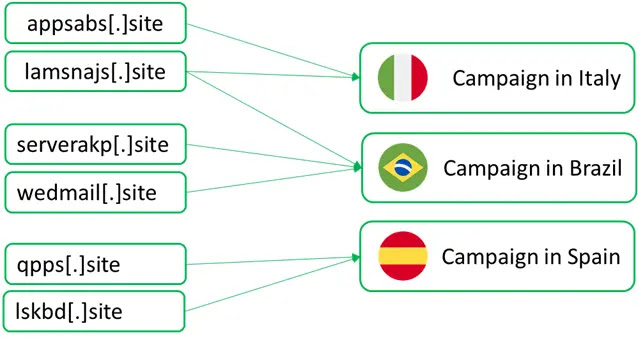
Domains doesn’t include any language checks (Source – Securelist)
The final payload is a Java-based RAT dubbed “SambaSpy,” and it was delivered via a JAR file hosted on MediaFire.
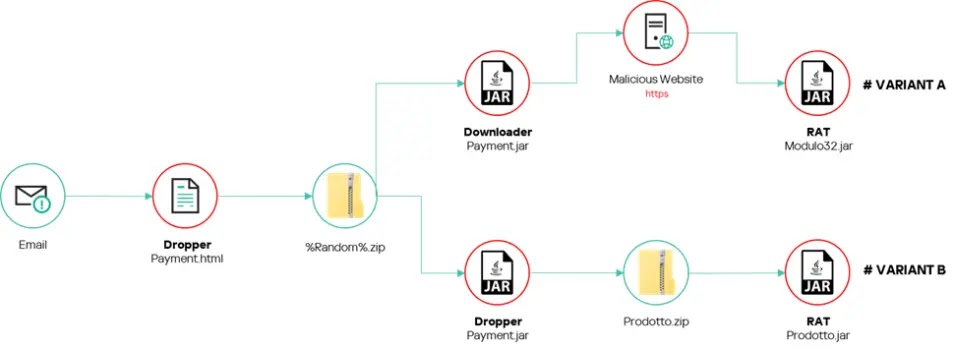
SambaSpy infection chain 1 (Source – Securelist)
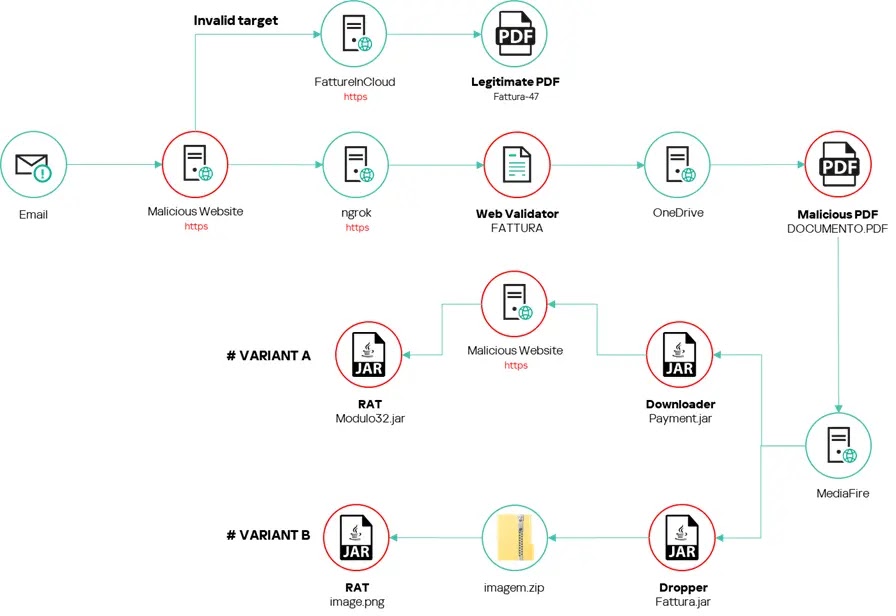
SambaSpy infection chain 2 (Source – Securelist)
SambaSpy is obfuscated using Zelix KlassMaster, and it offers an extensive range of malicious capabilities that we have mentioned below:-
-
File system manipulation
-
Process management
-
Keylogging (using JNativeHook)
-
Clipboard control
-
Webcam access
-
Screen capture
-
Remote desktop functionality
-
Browser credential theft (targeting Chrome, Edge, Opera, Brave, Iridium, and Vivaldi)
-
Ability to load additional plugins at runtime
Besides this, the RAT also implemented anti-VM techniques to evade detection, and for dynamic plugin loading, it utilized Java’s URLClassLoader.
This campaign’s focus and technical sophistication highlight an evolving trend in targeted cyberattacks.
The malicious actor took a complex approach by employing multiple stages of infection, including language checks to detect Italian scope and parameters.
They also made use of a legitimate invoice that acted as a vector to spread malware.
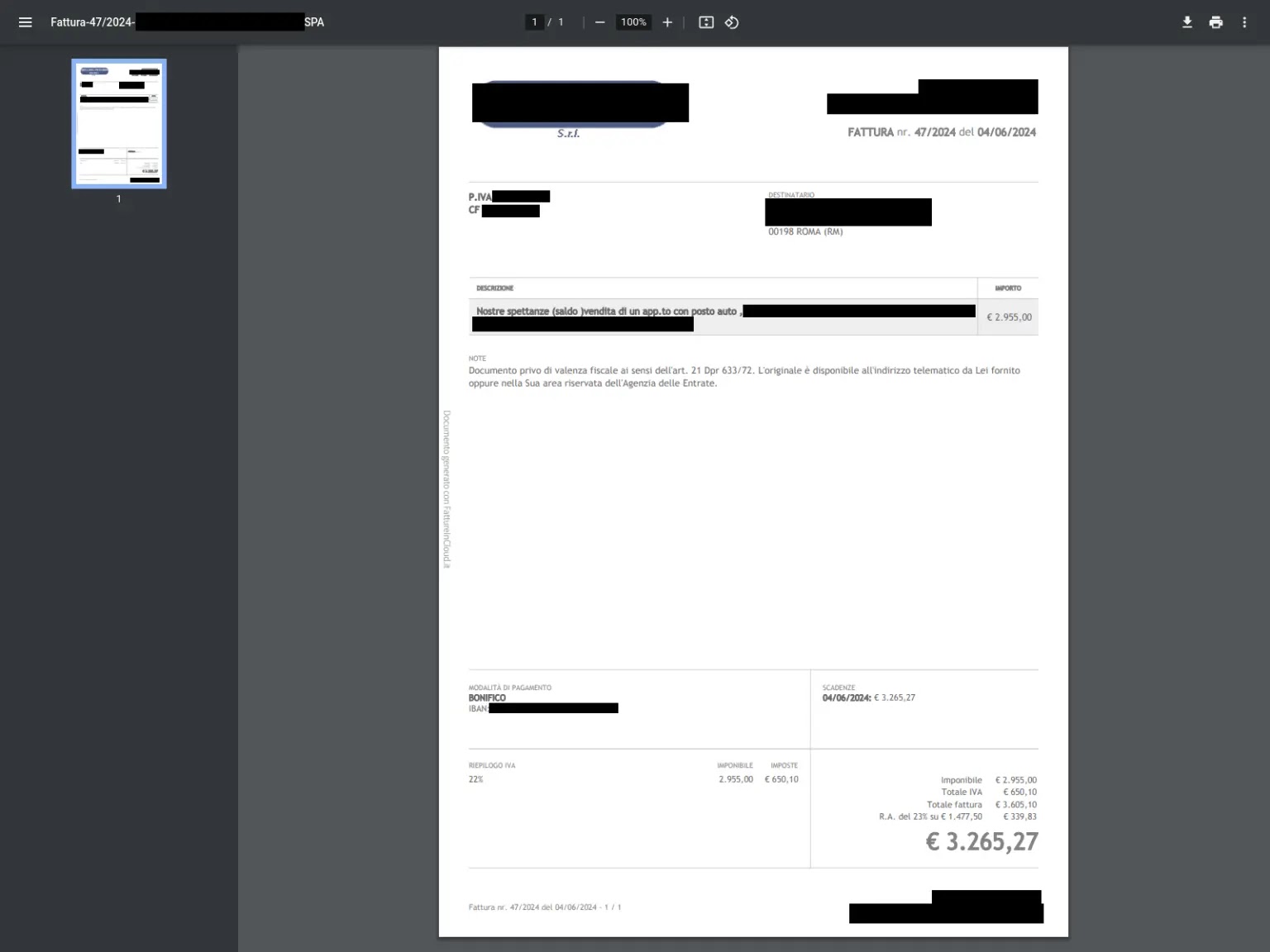
Invoice (Source – Securelist)
The campaign made use of a custom downloader with code comments and error messages in Brazilian Portuguese.
Here the threat actors often changed their strategies like obfuscation methods, phishing email content, and command-and-control (C2) endpoints.
Besides this, the attackers consistently reused second-level domains by providing insight into their infrastructure.
This pattern of infrastructure reuse, combined with language artifacts and targeting strategies, offers valuable indicators for attribution and enhances malware detection capabilities, Kaspersky said.
The campaign illustrates a trend of Latin American attackers targeting European countries with linguistically similar backgrounds.
Multiple language verification steps were implemented throughout the infection chain, which shows a focused approach to victim selection.
The rapidly evolving nature of attackers and their tactics creates challenges for cybersecurity researchers in tracking and mitigating such evolving threats.
IoCs
e6be6bc2f8e27631a7bfd2e3f06494aa Malicious PDF1ec21bd711b491ad47d5c2ef71ff1a10 Downloaderd153006e00884edf7d48b9fe05d83cb4 Dropper0f3b46d496bbf47e8a2485f794132b48 SambaSpy
Domain names embedded in email messages
officediraccoltaanabelacosta[.]netbelliniepecuniaimmobili[.]comimmobilibelliniepecunia[.]xyzimmobilibelliniepecunia[.]onlineimmobilibelliniepecunia[.]sitebpecuniaimmobili[.]onlinebpecuniaimmobili[.]infobelliniepecuniaimmobilisrl[.]shopbelliniepecuniaimmobilisrl[.]onlinebelliniepecuniaimmobilisrl[.]xyzbelliniepecuniaimmobili.com[.]brbpecuniaimmobili[.]xyzimmobilibelliniepecunia[.]shopimmobilibelliniepecunia[.]meimmobiliarebelliniepecunia[.]infoimmobiliarebelliniepecunia[.]online
Domain names used to distribute malware
lamsnajs[.]siteappsabs[.]siteqpps[.]sitelskbd[.]siteserverakp[.]sitewedmail[.]site66d68ce73c83226a.ngrok[.]apphxxps://1drv[.]ms/b/s!AnMKZoF8QfODa92x201yr0GDysk?e=ZnX3Rm PDF hosted on OneDrivehxxps://moduloj.lamsnajs[.]site/Modulo32.jpg URL embedded in downloader