Today’s businesses do not have physical boundaries around their operations. Infrastructures keep evolving with each passing day. Cloud instances come up and vanish within minutes. Identities proliferate in all kinds of SaaS applications. Integrations with third parties forge new trust links faster than security departments can vet them.
Security teams are losing visibility faster than most programs can adapt to the pace of change.
It’s not just about locating vulnerabilities anymore. The challenge lies in assessing which exposures are relevant, identifying connections between them, and determining if attackers can exploit them to gain access to sensitive assets.
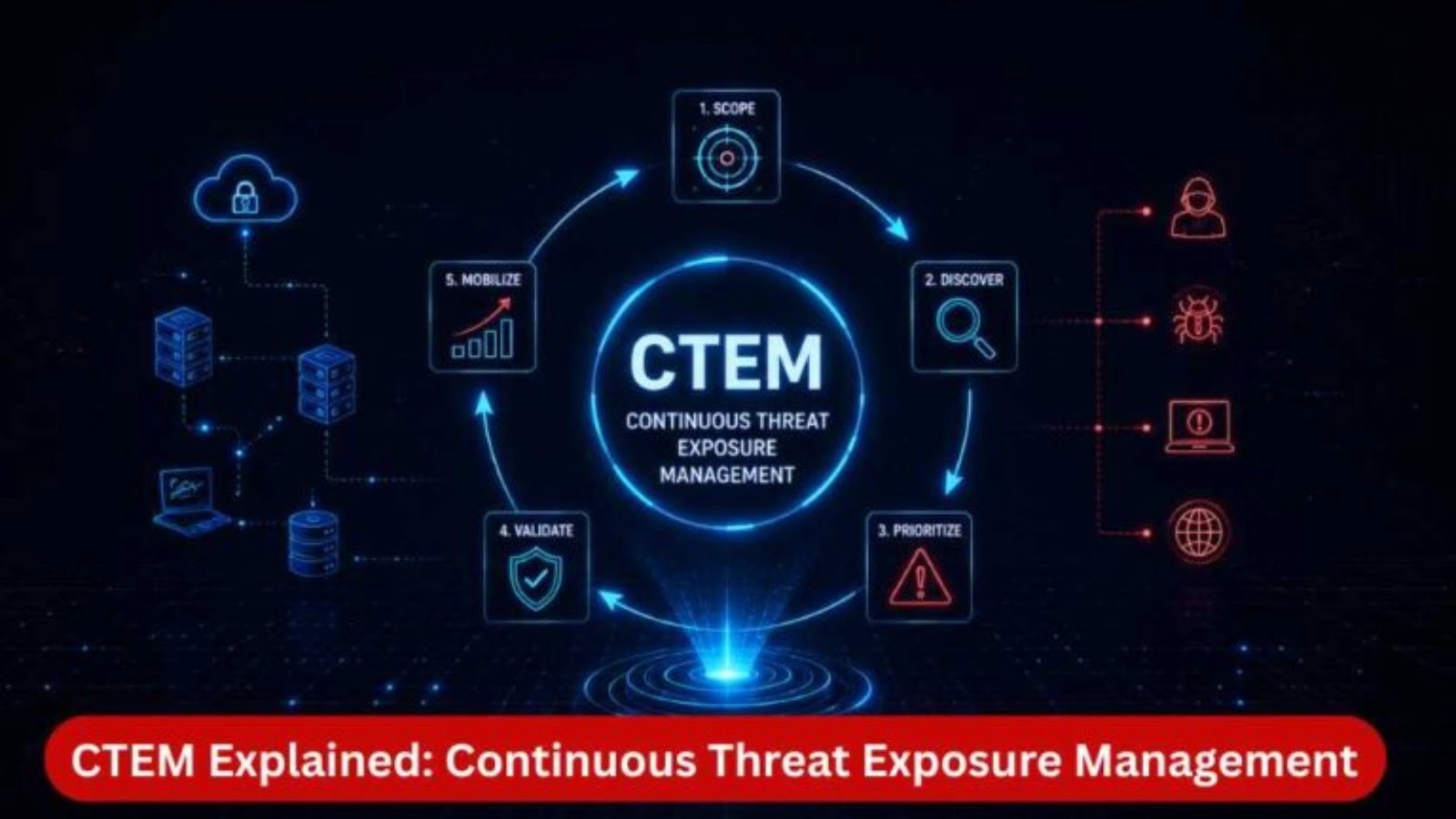
This is where Continuous Threat Exposure Management (CTEM) has seen rapid adoption.
Why attack surfaces keep expanding in hybrid and cloud environments
Attack surfaces used to grow predictably. Today, they expand continuously and often invisibly. Hybrid infrastructure changed the operating model completely, with assets now spanning public cloud platforms, on-premise infrastructure, SaaS applications, containers and Kubernetes environments, remote endpoints, identity providers, and OT and IoT systems.
Each environment comes with its own configurations, permissions, APIs, and dependencies. Security teams usually handle each layer independently via their respective tools, processes, and reporting. However, this sort of segmentation can create dangerous blind spots.
Isolated vulnerabilities do not necessarily present any risk. However, when a risk issue in a cloud misconfiguration is combined with identity permissions issues and a vulnerable internet-exposed workload, then the story becomes quite different.
Attackers understood this before most defenders did.
Modern attacks very rarely depend on just one weakness. Rather, attackers will exploit all available flaws and chain them together to reach their valuable targets, which is why visibility is critical in today’s cybersecurity.
But the problem is that visibility alone is no longer enough.
What does CTEM actually change?
CTEM forces security teams to think differently about exposure.
Vulnerability management has usually been about trying to find as many vulnerabilities as possible, then prioritizing them based on scores for severity. This creates overwhelming remediation backlogs with too little context around exploitability or possible business impact.
CTEM brings a far more continuous and contextual model. The CTEM approach examines not just each vulnerability individually, but how vulnerabilities, identities, configurations, and other assets affect each other.
It leads to a better awareness of what assets are actually vulnerable and what attack paths can be exploited, as well as what vulnerabilities pose a risk to the organization and, crucially, what measures should be taken to mitigate risk.
This is where exposure management becomes operationally useful instead of simply informational. Security personnel can focus on attackers’ behavior rather than just severity.
How CTEM improves visibility across on-prem and cloud assets
One of the most significant drawbacks of many security systems is the lack of visibility across different environments.
Cloud security teams monitor a set of tools, while infrastructure teams use another set of solutions. Identity governance teams act independently of these two. Add to this that vulnerability scanners create vast data sets without any contextualization.
As a result, organizations battle to answer relatively straightforward questions:
- What internet-exposed assets are still exposed?
- What identities are overprivileged?
- What misconfigurations leave us vulnerable?
- What vulnerabilities can be accessed from our critical systems?
- What cloud assets are unmonitored anymore?
CTEM improves visibility because it constantly correlates vulnerabilities, asset inventory, identity exposure, cloud attack surface management, configuration weaknesses, privilege escalation opportunities, internet exposure, and lateral movement pathways, rather than analyzing each in isolation.
This unified exposure insight matters because bad actors don’t care about internal organizational silos; they move opportunistically across environments.
Security teams need the same cross-environment perspective.
Why risk-based prioritization matters more than vulnerability volume
Many companies use the number of vulnerabilities fixed to assess security maturity. This approach is becoming less relevant.
The modern business faces a vast number of vulnerabilities every day. Trying to fix all of them equally would be practically impossible. But even more importantly, fixing all of them might not lower risks at all.
A minor vulnerability in the identity path is probably more important than a critical one in a segment far from exposure.
That means companies need to understand vulnerability exploitation, the criticality of affected assets, identity dependencies, accessibility, compensating controls, how long they’ve been exposed, and the operational impact of a breach.
One reason exposure assessment is now so important for proactive defense is that organizations must determine not only what is vulnerable, but what should be considered an operational threat.
Using CTEM to uncover hidden attack paths
In most instances, cyberattacks involve movement through the environment, not an initial compromise alone.
Adversaries almost never compromise one workload and remain within it. Instead, they move laterally between resources, misuse privileges, escalate privileges, and leverage trust relationships.
Conventional security solutions find it difficult to depict such attack vectors, as the information is isolated.
However, CTEM helps connect these exposures and depict attack vectors from an attacker’s perspective. A seemingly minor exposure can unravel fast — an exposed admin ID, weak segmentation, over-permissioned cloud accounts, internet-facing services, reused credentials, an unpatched edge: each one unremarkable in isolation, but devastating when chained together.
This context-driven analysis helps security teams pinpoint the quickest ways threat actors might exploit their way into critical systems.
The result is a drastic shift in how they prioritize their remediation efforts. Rather than fixing all the vulnerabilities one by one, teams can concentrate on disrupting potential attack pathways.
It usually leads to quicker risk mitigation with less effort.
From reactive defense to preemptive security
Some organizations continue to function reactively.
They probe incidents when signs of compromise are detected. They deal with threats after the attacker gains a foothold. They take remediation action only after exploitation is announced.
This approach doesn’t work in modern environments.
Cloud environments change rapidly, as do identity landscapes. Cybercriminals automate discovery and exploitation at a rate far faster than people can handle.
Continuous awareness of exposure prior to any incident is essential for preemptive security. This is where continuous exposure management becomes so crucial.
By continuously assessing attack surface modifications, identity exposure, vulnerabilities, and attack paths, it is possible to reduce exposure early in the attack cycle.
The shift is significant. Teams move away from reactionary responses, alert fatigue, static analysis, and siloed technologies, toward constant visibility, proactive protection, context-based prioritization, and the ability to disrupt attack paths before they’re walked.
The objective is not to remove all vulnerabilities: this is not possible in complex hybrid systems. Rather, it is minimizing the chance that attackers will exploit exposures to create an impact on business.
Why exposure management is becoming a board-level conversation
Cybersecurity risk is increasingly recognized among executives as more than just malware and perimeter protection.
Modern business risk depends on assessing exposure in cloud environments, identity, infrastructure, and third parties.
The board wants better answers to questions such as:
- Where are our greatest vulnerabilities?
- What exposures pose business risk?
- How fast are we closing our exposure on attack surfaces?
- Which risks are still unresolved?
- Are we increasing preemptive security maturity?
Exposure management is key in translating technical insights into risk terms.
This explains why the CTEM approach can be useful not just for security operations groups, but also for risk and compliance executives who need a better gauge of resilience.
Those organizations that depend on piecemeal scanning systems and reporting are likely to have difficulty keeping up with the current pace of attack surface threats.
Organizations that still rely on fragmented visibility and static assessments are already operating behind the pace of modern attack surfaces.
Kirsten Doyle has been in the technology journalism and editing space for nearly 24 years, during which time she has developed a great love for all aspects of technology, as well as words themselves. Her experience spans B2B tech, with a lot of focus on cybersecurity, cloud, enterprise, digital transformation, and data centre. Her specialties are in news, thought leadership, features, white papers, and PR writing, and she is an experienced editor for both print and online publications. She is also a regular writer at Bora.