Overall Rating
Overall Rating: ⭐⭐⭐⭐☆ 4.7 / 5
| Protocol Transparency | 4.7 / 5 |
| Speed & Performance | 4.6 / 5 |
| Streaming | 4.7 / 5 |
| Privacy & Security | 4.8 / 5 |
| Ease of Use | 4.8 / 5 |
A well-rounded VPN with clear protocol choice, solid performance, and stronger trust signals in 2026.
Developed by LIGHTNINGLINK NETWORKS PTE. LTD., a Singapore-based company, X-VPN has grown into a much broader product than many users may remember, especially in areas like protocol support and privacy transparency.
In this review, we focused primarily on how X-VPN handles protocol choice in practice, looking at its support for OpenVPN, WireGuard, and its proprietary Everest protocol, and whether those options feel meaningful rather than merely technical.
Our early impression is that X-VPN now presents a more transparent picture than before. The combination of open protocols and a proprietary option gives users more flexibility across different use cases, while its recently completed independent no-logs audit, finished on February 28, 2026 under ISAE 3000 (Revised) and conducted by Deloitte Singapore, adds a stronger trust signal to the service overall.
Protocols
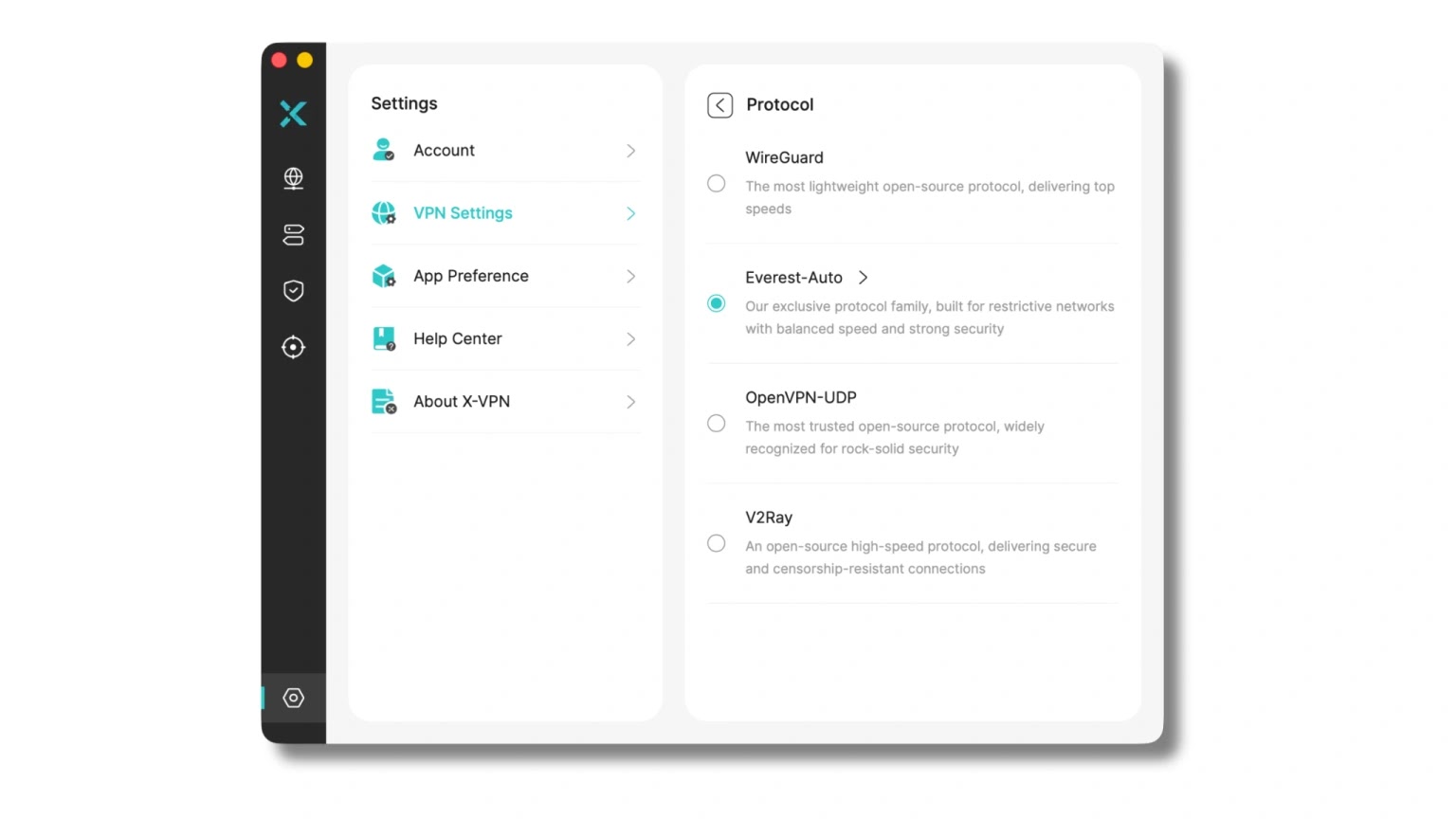
X-VPN currently supports four protocol options: OpenVPN, WireGuard, V2Ray, and its proprietary Everest protocol. From a review standpoint, that is a useful mix. Three of the options are well-known open-source protocols, while the fourth is X-VPN’s own protocol designed for more specialized connection handling.
Just as importantly, the overall protocol selection remains broadly similar across both the free and premium plans, so protocol choice is not limited entirely to paid users. That gives the protocol setup a more transparent feel than a simple “auto-connect only” approach.
OpenVPN: A Proven Option for Security-Focused Users
X-VPN presents OpenVPN as a widely recognized protocol with rock-solid security, which is a fair way to frame it. As one of the best-known open-source VPN protocols, OpenVPN is still associated with mature security, dependable stability, and broad trust among users who prefer a more established connection method.
That translates into a practical advantage for people who prioritize reliability in everyday use, especially on public Wi-Fi or during more privacy-sensitive sessions. X-VPN also takes a relatively transparent approach here by allowing users to choose OpenVPN on both its free and premium plans, rather than limiting open-source protocol access to paid subscribers only.
WireGuard: A Faster Option for Everyday Use
X-VPN presents WireGuard as its more speed-focused open-source protocol, and that is broadly how it fits into the lineup. Compared with more traditional options, WireGuard is typically associated with faster connections, lower overhead, and a smoother experience for everyday tasks like browsing, streaming, and mobile use.
That gives it a clear practical role for users who want better responsiveness in daily use. X-VPN also takes a relatively transparent approach by making WireGuard available on both its free and premium plans.
Everest: X-VPN’s Exclusive Protocol for Restrictive Networks
Everest is X-VPN’s exclusive protocol, positioned as an option built for restrictive networks with a balance of speed and strong security. More broadly, it reflects X-VPN’s in-house anti-blocking protocol development, which dates back to 2017 and makes the company one of the earlier VPN providers to invest in proprietary anti-blocking protocols for restrictive network conditions.
It uses AES-256 encryption, supports multiple transmission protocols such as UDP, TCP, HTTP, and TLS, and incorporates obfuscation and disguise techniques to make VPN traffic harder to identify and block.
Rather than replacing OpenVPN or WireGuard, it appears intended as an additional option for users who may need better connectivity under more restrictive network conditions. Everest is designed as a more specialized option for situations where obfuscation and anti-blocking capability may matter more than protocol openness alone.
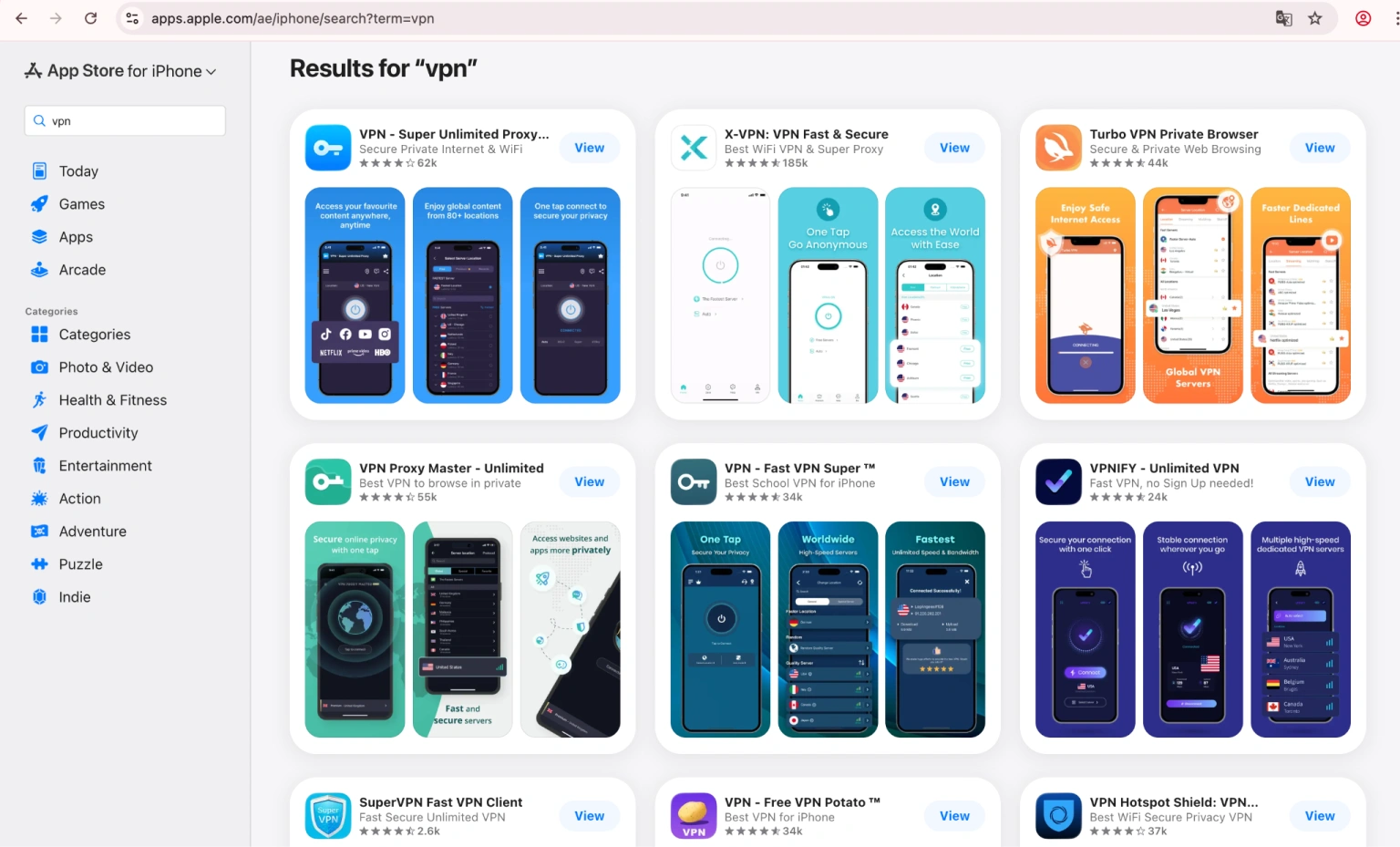
X-VPN has also performed particularly well in countries where internet access is more tightly restricted, suggesting that its anti-blocking capabilities are not just theoretical, but have translated into strong real-world adoption and market visibility. In the UAE, for example, X-VPN ranked No. 2 in the App Store’s VPN category
V2Ray: A High-Speed Option for Censorship-Resistant Connections
X-VPN presents V2Ray as an open-source high-speed protocol built for secure, censorship-resistant connections. That gives it a distinct role in the lineup, particularly for users who may want both speed and better resilience under more restrictive network conditions.
It also appears to be an area X-VPN is still actively improving. The company has recently optimized V2Ray performance on Mac, leading to further speed gains on that platform.
Does X-VPN Offer Real Protocol Choice?
At this stage, the answer is yes. Taken together, X-VPN’s protocol lineup feels more considered than a simple one-protocol setup. OpenVPN and WireGuard cover the more familiar open-source choices, while Everest and V2Ray appear to serve more specialized roles under restrictive network conditions.
In practice, that gives users more room to choose based on what matters most to them, whether that is privacy, speed, or stronger unblocking performance.
Speed
Speed is one of the more practical ways to judge whether X-VPN’s protocol lineup translates into real use. For this review, we tested X-VPN on Mac using V2Ray, which is positioned within X-VPN’s lineup as a high-speed option for censorship-resistant connections. They have also recently optimized V2Ray on Mac, bringing further speed improvements on that platform.
Test Setup
Rather than measuring only a single nearby connection, we tested X-VPN across four scenarios: without VPN, local server, mid-distance servers, and a long-distance server. This gives a more useful picture of how the service holds up as routing distance increases.
It is also worth noting that our lab environment runs on a significantly higher-bandwidth connection than what many consumer VPN tests use. That gave us more room to observe X-VPN’s upper-end throughput under relatively unconstrained conditions, rather than hitting the limits of the test line too early.
Download Speed Results
| Scenario | Download Speed |
| No VPN | 3492 Mbps |
| Local Server | 2786 Mbps |
| UK Server | 2688 Mbps |
| Germany Server | 2745 Mbps |
| US Server | 2762 Mbps |
Overall, most results fell within the 2600–2800 Mbps range, indicating relatively stable performance across regions.
What the Results Show
The most obvious pattern is that X-VPN remained fairly consistent once connected. As expected, the no-VPN baseline was the fastest result, while the local server delivered the strongest VPN performance. The UK, Germany, and US results came in slightly lower, but not by a dramatic margin.
That matters because distance-based variation is normal in VPN testing. Longer routes typically introduce more overhead, and some drop-off is expected as traffic travels farther. Here, though, the spread between mid-distance and long-distance results remained relatively narrow, which suggests that X-VPN’s performance stayed stable rather than falling off sharply across regions.
Performance Verdict
Based on these results, X-VPN comes across as a strong performer in raw speed, particularly when tested in a high-capacity environment that allows its ceiling to show more clearly. More importantly for a review like this one, the service did not just post one strong local result and then weaken dramatically at longer distances.
The overall pattern was steadier than that, which supports the impression that X-VPN’s network is built for more than short-range performance alone.
Streaming

Streaming is one of the areas where X-VPN feels particularly well-positioned. It supports access to a broad set of major platforms, including Netflix, HBO Max, Amazon Prime Video, BBC iPlayer, Hulu, Roku, YouTube TV, ESPN, and Disney+. It also offers dedicated servers for streaming.
Streaming Test Results
| Platform | Unblocked | 4K Playback Supported | Notes |
| Netflix | Yes | Yes | Unblocked US, AU, BR, CA, GB, JP, KR libraries successfully |
| HBO Max | Yes | Yes | / |
| Amazon Prime Video | Yes | Yes | / |
| BBC iPlayer | Yes | Yes | / |
| Hulu | Yes | Yes | / |
| Roku | Yes | Yes | / |
| YouTube TV | Yes | Yes | / |
| ESPN | Yes | Yes | / |
| Disney+ | Yes | Yes | / |
What the Results Show
The strongest takeaway here is coverage. X-VPN is not limited to one or two headline platforms; it handles a wider mix of region-based and mainstream streaming services, with Netflix standing out in particular thanks to support for multiple libraries, including the US, Australia, Brazil, Canada, the UK, Japan, and South Korea.
The results also suggest that X-VPN’s streaming setup is not just about access, but about maintaining a higher-quality viewing experience once connected. Being able to stream Netflix in 4K matters more than simply loading the site successfully, because it points to a network that can sustain both throughput and stability under heavier playback demands.
Streaming Verdict
Taken together, X-VPN delivers a strong streaming showing. The combination of broad platform support, dedicated streaming servers, and stable high-speed results makes it feel well suited to users who want a VPN primarily for streaming access rather than just occasional location switching.
Security & Privacy
Security and privacy are closely linked in X-VPN’s current setup. Beyond its protocol options, the service also includes a set of core protections and extra tools that are meant to strengthen everyday use. At the same time, its no-logs policy now carries more weight than before because X-VPN has completed an independent no-logs audit.
Security Features
X-VPN covers the core security features most users would expect from a modern VPN. It includes AES-256 encryption and a kill switch, both of which remain important baseline protections for keeping traffic encrypted and preventing accidental exposure if the VPN connection drops. On top of that, X-VPN also offers additional tools that go beyond the VPN tunnel itself, including ad blocker, Tracker Blocker, download protection, and cookie blocker.
Taken together, these tools make X-VPN feel more like a broader privacy package rather than just a basic connection service. They are especially useful for users who want extra protection during everyday browsing, not only while routing traffic through the VPN.
No-Logs Policy
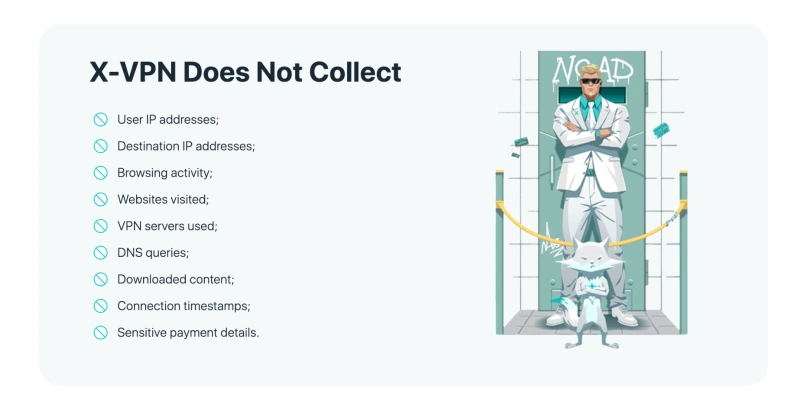
On the privacy side, the bigger development is that X-VPN has now completed its independent no-logs audit, which was finished on February 28, 2026 under ISAE 3000 (Revised), with Deloitte as the audit firm. That gives the service a stronger trust signal than a no-logs claim on its own.
According to the audit scope and result summary, X-VPN does not track, collect, or store data that could identify users or reconstruct their activity, including user IP addresses, destination IP addresses, websites visited, browsing history, VPN servers used, DNS queries, downloaded content, VPN connection timestamps, and sensitive payment details.
Security & Privacy Verdict
Overall, X-VPN presents a stronger security and privacy profile than a simple feature list might suggest. The security tools help improve day-to-day protection, while the completed no-logs audit gives its privacy claims more structure and credibility than before.
Server Network
Network Size and Coverage
X-VPN’s premium network now spans 10,000+ servers across 80 countries, which gives it fairly wide geographic reach by consumer VPN standards. The free version still offers 1,000+ free servers in 26 locations, including the US, Canada, the UK, France, and Germany, with city-level server options also available in the US. That is a meaningful split: the free tier is usable enough for general access, while the premium tier is the one that provides broader routing choice and more room for performance optimization.
Why the Network Matters
In practical terms, this wider network helps support several parts of the experience at once. It gives users more flexibility in choosing nearby or regional servers, improves the odds of finding a less congested route, and makes it easier for the service to support streaming-focused use cases across multiple regions.
Ease of Use
Overall, X-VPN generally keeps the user experience straightforward.
Clean, Beginner-Friendly Interface
In day-to-day use, X-VPN’s interface feels relatively approachable. The layout is simple enough for beginners to connect quickly, but it still leaves room for users who want to explore different protocol or server options instead of relying only on the default connection flow. That balance works well for a product that is trying to offer more flexibility without becoming overly technical.
Easy Access on the Free Version
One of the more practical strengths here is that the free version does not require users to create an account before getting started. There is no mandatory sign-up or email step just to begin using the service, which lowers the barrier to entry quite a bit.
For users who want to test the app first or simply prefer a faster setup process, that makes X-VPN easier to approach than services that place account creation at the very start of the experience.
Broad Platform Support
X-VPN also benefits from wide platform coverage. The free version is available on Windows, macOS, iOS, Android, and Chrome Extension, which gives it a fairly flexible footprint across both desktop and mobile use. That kind of support is especially helpful for users who want a more consistent experience across different devices rather than treating VPN use as something limited to one platform.
Ease of Use Verdict
Overall, X-VPN gets the usability basics right. The apps feel accessible, the free version is easy to start using, and the broader platform support helps the service feel convenient rather than restrictive. Just as importantly, the product manages to offer more protocol flexibility without making the experience feel complicated for everyday users.
Pricing & Value
On its official website, X-VPN currently lists three plans: $11.99 for one month, $47.99 for the first 12 months, and $69.99 for the first 24 months.
Free vs Premium
X-VPN’s free plan remains more usable than many entry-level VPN tiers, but Premium is where the service opens up more fully in terms of speed, server choice, and extra controls.
| Feature | Free | X-VPN Premium |
| Traffic | Infinite | Infinite |
| Speed | Unlimited | Ultra-Fast |
| Locations | 50+ | 250+ |
| Global Servers | 1000+ | 10,000+ |
| Kill Switch | Yes | Yes |
| 24/7 Live Support | Yes | Yes |
| Streaming Servers | No | Yes |
| Security Protection | No | Yes |
| Split Tunneling | No | Yes |
Is Premium Worth Paying For?
That depends mostly on how often you plan to use the VPN. For casual use, the free version remains unusually accessible because it removes the sign-up barrier and still covers the basics well.
Premium starts to make more sense if you want broader location choice, more consistent streaming performance, and extra features such as Split Tunneling across more devices.
Refund Policy
For users who want to try Premium with less risk, X-VPN says purchases made through its official website are covered by a 30-day money-back guarantee. The company also notes that it supports the free trial.
Pricing Verdict
Overall, X-VPN’s pricing feels fairly straightforward. The monthly plan is predictable, the long-term plan is where the real value sits, and the free version remains useful enough that upgrading does not feel forced too early.
Final Verdict
X-VPN feels more rounded and more clearly positioned in 2026 than it did in earlier iterations. Its protocol lineup is one of the stronger parts of the service, with OpenVPN and WireGuard covering the more familiar open-source choices, while Everest and V2Ray give it more flexibility in restrictive network conditions.
On top of that, the service also backs up the broader experience with a large premium network, dedicated streaming servers, useful security tools, and a free version that remains unusually usable rather than heavily stripped down.
Just as importantly, X-VPN’s privacy position now carries more weight than a standard marketing claim. Its independent no-logs audit, completed on February 28, 2026 under ISAE 3000 (Revised) with Deloitte, gives the product a stronger trust signal and makes its overall transparency story more convincing.
Overall, X-VPN comes across as a strong option for users who want more than a simple one-click VPN. It combines real protocol choice, strong streaming support, solid speeds, and improved privacy credibility in a way that feels more mature and better balanced than before.
FAQ
Is X-VPN private enough?
Yes. X-VPN now has a stronger privacy case because it has completed an independent no-logs audit, finished on February 28, 2026 under ISAE 3000 (Revised) with Deloitte as the audit firm.
According to the audit summary, X-VPN says it does not log identifiable activity data such as IP addresses, browsing history, DNS queries, downloaded content, sensitive payment details, or VPN connection timestamps.
Which protocols does X-VPN support?
X-VPN supports OpenVPN, WireGuard, Everest, and V2Ray. In practical terms, OpenVPN and WireGuard are the more familiar open-source options, while Everest and V2Ray are positioned for more specialized use, particularly under restrictive network conditions.
Is X-VPN safe?
Overall, yes. X-VPN includes core protections such as AES-256 encryption and a kill switch, along with extra privacy tools like ad blocker, tracker blocker, download protection, and cookie blocker. Combined with its completed no-logs audit.
Are X-VPN’s protocols open-source?
X-VPN supports open-source protocols including OpenVPN, WireGuard and V2Ray. Its Everest protocol is proprietary and is positioned as a specialized option for restrictive network conditions. This gives users more flexibility to choose based on their own needs, whether they prioritize privacy and security, speed, or stronger unblocking performance.