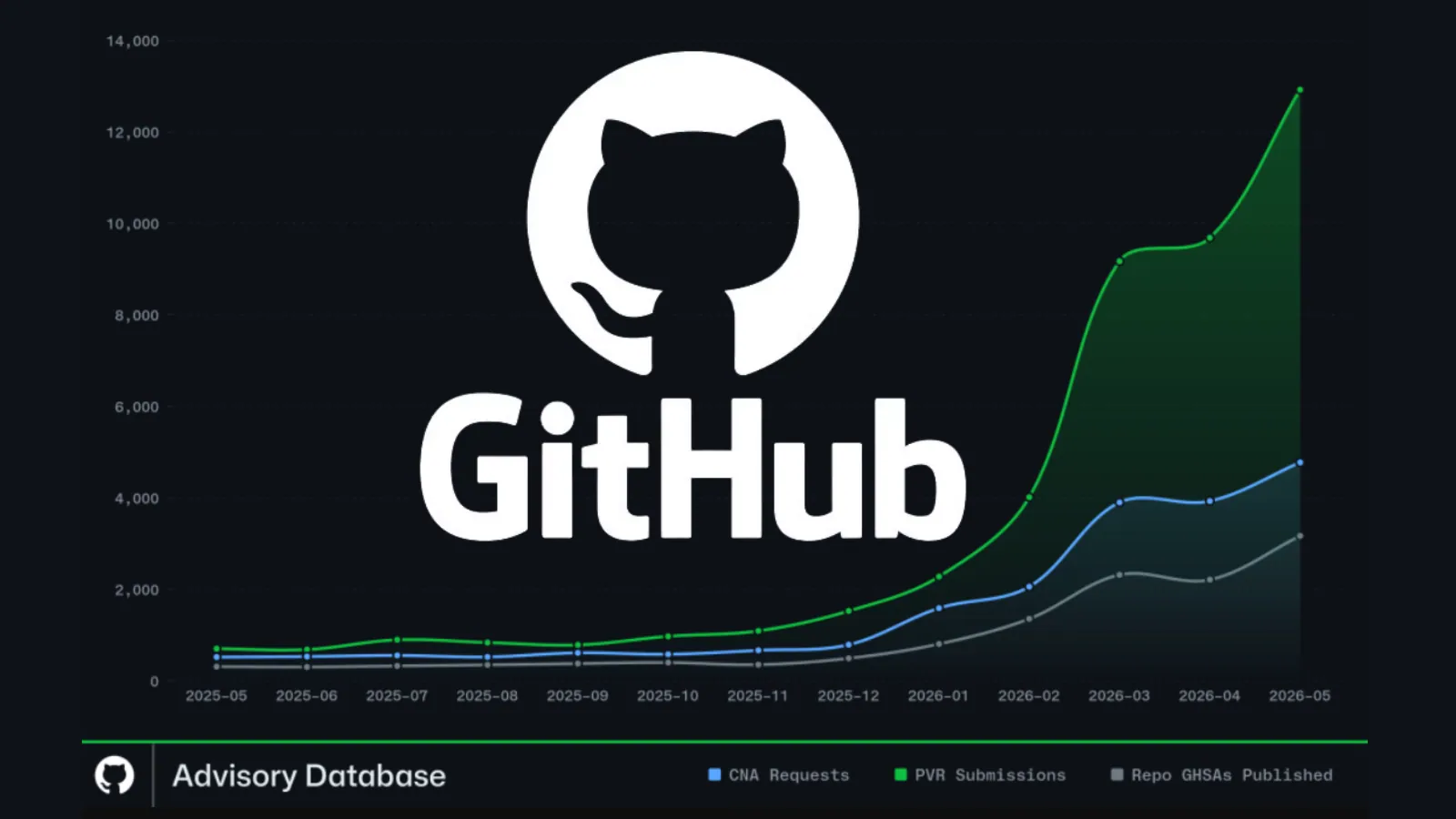
GitHub’s Advisory Database reached an all-time high in May 2026, publishing 1,560 reviewed security advisories, more than five times its typical monthly output.
Despite this milestone, the platform still struggled to keep pace with a rapidly expanding volume of vulnerability reports, reflecting a broader shift in the global vulnerability disclosure ecosystem.
According to GitHub, the surge is not a temporary spike but part of a sustained trend. Between March and May 2026, the platform processed over 6,000 advisory decisions per month, including new publications, updates, and inbound reviews.
At the same time, incoming data increased sharply across all sources. Private vulnerability reports rose from around 550 per week in January to over 3,000 per week in May, while repository advisories exceeded 5,000 submissions per week.
CVE requests also saw a dramatic increase, with nearly 4,000 submitted through GitHub’s CNA (CVE Numbering Authority) in May alone, almost 10 times year-over-year.
GitHub Advisory Database Hits Record Vulnerabilities
Globally, more than 30,000 CVEs have already been published in 2026, highlighting the growing scale of vulnerability discovery and disclosure.
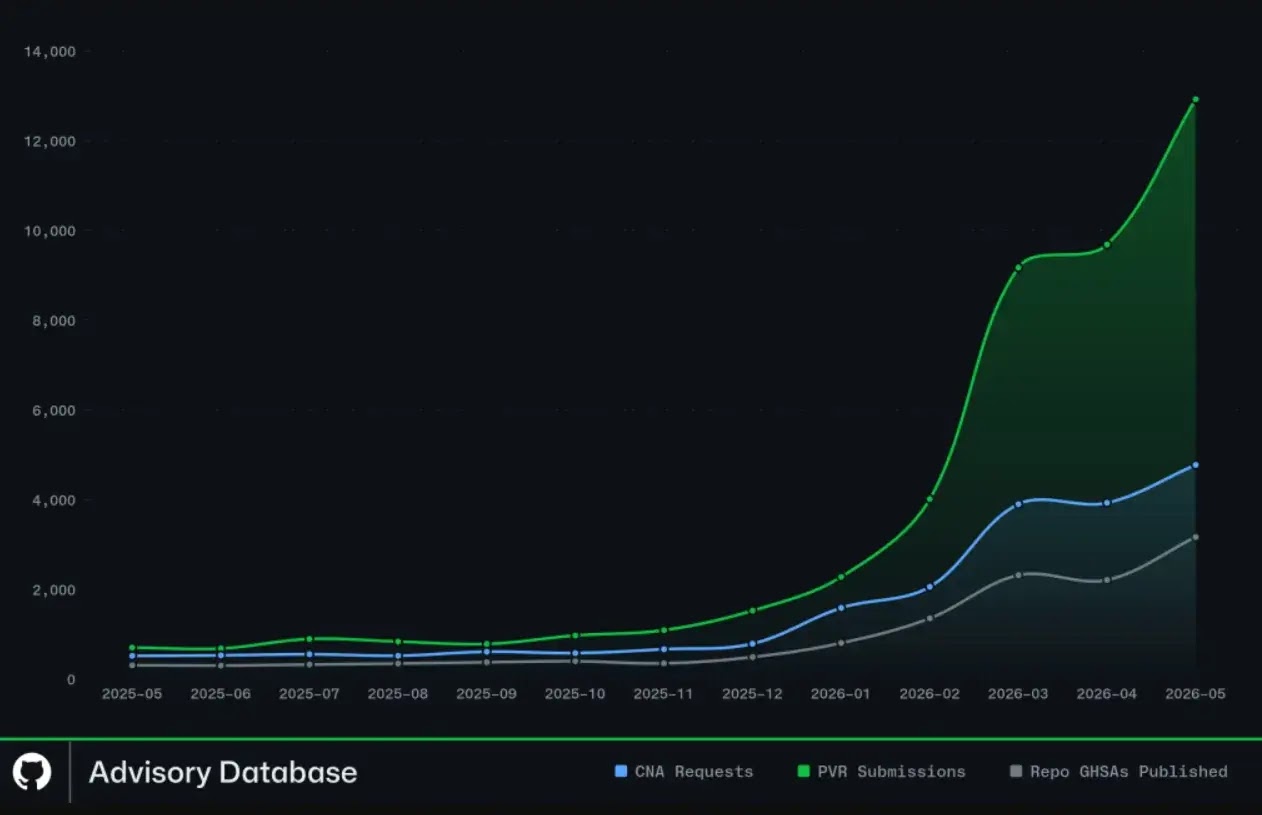
This surge has directly impacted advisory processing timelines. Since mid-April, GitHub has been unable to meet its internal publication targets consistently.
Review times have extended from days to multiple weeks in some cases, increasing potential exposure windows for unpatched vulnerabilities.
Despite the delays, GitHub said all reviewed advisories continue to undergo human validation, ensuring accurate package mapping, affected versions, and severity classification.
CVE assignment rates have remained stable between 91% and 94%, indicating that submission quality has not significantly declined.
The primary challenge lies in throughput rather than system failure. GitHub’s infrastructure and data pipelines continue to function as designed. However, the complexity and volume of incoming advisories now exceed the system’s original capacity.
Not all advisories require the same level of effort. Well-structured reports with clear package names, version ranges, and fixes can be reviewed within minutes.
However, an increasing number of submissions require deeper investigation, such as resolving package ambiguities across ecosystems, reconstructing missing version data, and reconciling conflicting upstream information.
For example, a vulnerability reported in a shared library may affect both npm and NuGet packages, requiring separate validation across ecosystems.
In other cases, inconsistent data between CVE records and repository commits forces curators to verify the correct impact manually.
To address these challenges, GitHub is scaling its operations by improving triage systems, expanding backend capacity, and deploying AI-assisted research tools.
These tools help automate repetitive tasks while preserving human oversight for critical validation steps. The company is also investing in better documentation and training to onboard new reviewers more efficiently.
Looking ahead, GitHub plans to enhance risk-based prioritization by factoring in real-world signals such as exploitation activity and package usage.
It is also working to improve data quality at the source by strengthening integration with upstream reporting systems.
The company emphasized that community participation remains critical. Researchers and maintainers are encouraged to submit complete and accurate vulnerability data, including CVSS vectors, CWE classifications, and precise package identifiers.
High-quality submissions can significantly reduce review time and improve overall ecosystem efficiency.
This record-breaking growth reflects a fundamental shift in cybersecurity. More organizations are adopting responsible disclosure, more researchers are identifying vulnerabilities, and more maintainers are publishing fixes.
While this creates operational pressure, it also marks progress toward greater transparency and improved security across the software supply chain.