Most SOCs measure threat intelligence the same way they measure storage: bigger is better.
A feed that delivers two million indicators a month looks more impressive on a vendor scorecard than one that delivers two hundred thousand. Dashboards proudly display IOC counts in the millions.
Procurement decisions get justified by “coverage.” And yet, ask almost any SOC analyst how many of those indicators they’ve actually looked at, matched against a log, or used to close an investigation, and the answer is usually somewhere between “not many” and “no idea.”
This is the quiet contradiction at the center of modern threat intelligence: teams are drowning in indicators while starving for usable intelligence.
Volume and value have become decoupled, and most security programs haven’t noticed because nobody is measuring the difference.
The Difference Between Threat Data and Threat Intelligence
An IOC is not automatically useful simply because it is labeled malicious. An IP address, domain, or an URL becomes operationally valuable only when it is:
- Relevant to the organization’s threat profile;
- Recent enough to reflect active malicious activity;
- Supported by sufficient context and confidence;
- Delivered in a format that security controls and analysts can use;
- Connected to a clear detection, investigation, or response workflow
Without these qualities, an IOC is merely a data point. It may look impressive in a dashboard, but it does not necessarily improve defensive outcomes.
It sounds counterintuitive. Surely more data means more detection surface, more chances to catch something bad. In practice, the relationship breaks down past a certain point. Every indicator a SOC ingests carries a cost (storage, query time, enrichment overhead, analyst attention), and that cost doesn’t scale down just because the indicator turns out to be irrelevant, stale, or wrong.
When the volume of incoming IOCs outpaces the team’s ability to validate and act on them, three things tend to happen: signal gets buried under noise, analysts develop a learned indifference to alerts, and the SOC’s actual detection capability quietly degrades even as its “threat coverage” metrics go up.
A SOC that ingests ten feeds and trusts none of them is, in a meaningful sense, less effective than one that ingests one feed and trusts it completely.
Feed Fatigue Is a Security Operations Problem
Security teams are already surrounded by telemetry. Logs, endpoint events, cloud alerts, email detections, identity signals, network activity, vulnerability data, and external intelligence all compete for attention.
Adding more feeds without improving prioritization can produce feed fatigue: a state where analysts have access to abundant intelligence but limited confidence in what deserves action.
Feed fatigue appears in several ways:
- Analysts stop trusting enrichment results because too many are low-value.
- Teams disable or tune down detections to control alert volume.
- Security engineers spend time maintaining integrations instead of improving coverage.
The issue is not that feeds are inherently noisy. The issue is that intelligence is often treated as a bulk import rather than a decision-support layer.
A feed should help an analyst answer questions such as:
- Is this domain part of an active phishing campaign?
- Has this IP recently communicated with malware?
- Is this file associated with a known threat family?
- Should this alert be escalated, blocked, or closed?
If a feed cannot improve those decisions, its volume becomes a burden rather than an advantage.
Why Volume Is an Attractive but Misleading Metric
Large IOC counts are easy to market and easy to celebrate. A feed containing millions of indicators can sound more comprehensive than one focused on fewer, high-confidence observations. But volume alone does not answer the questions that matter to a CISO or SOC leader:
- How many indicators were relevant to our environment?
- How many improved detection or investigation outcomes?
- How many were fresh when they reached our tools?
- How many generated false positives or redundant alerts?
- How much analyst time did they save or consume?
- How quickly could the SOC act on them?
The most valuable threat intelligence is not necessarily the largest collection. It is the intelligence that reaches the right workflow, with the right context, at the right time.
Moving from Volume to Verified Relevance
The fix isn’t fewer indicators for the sake of fewer indicators. It’s indicators that come pre-validated against real, recent, observed attacker behavior, with the context attached that lets an analyst trust them without re-deriving that trust from scratch every time.
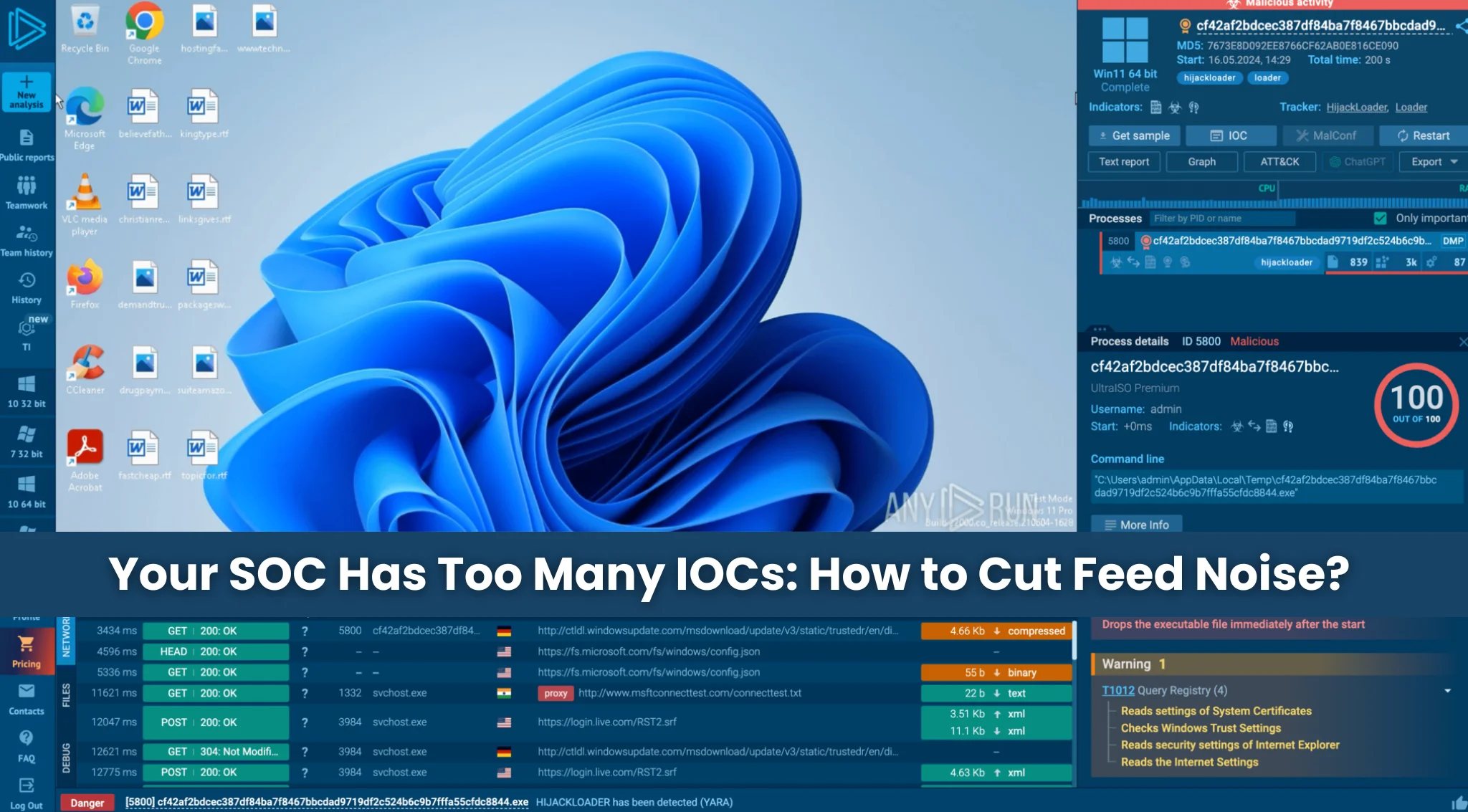
Each IOC ships with the context that makes utilization possible in the first place: links to the original sandbox session with MITRE ATT&CK TTPs and network behavior, malware family labels, and severity scoring — the difference between “here’s an IP” and “here’s an IP, here’s what it did, and here’s the proof.”
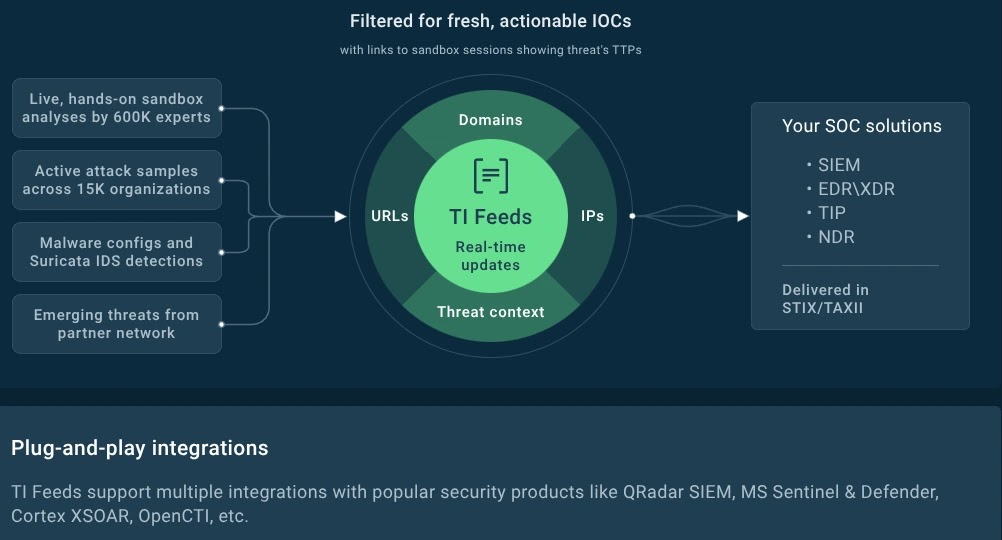
That contextual layer is also what keeps the noise down. Indicators are continuously refreshed and pre-processed to filter out stale or low-confidence entries, which is reflected in a near-zero false-positive rate compared to the long tail typical of open or aggregated feeds.
The feeds can be integrated into SIEM, SOAR, EDR, XDR, TIP, firewall, and other security workflows. This makes it possible to operationalize intelligence where analysts and controls already work, whether the goal is automated enrichment, detection tuning, proactive threat hunting, or blocking known malicious infrastructure.
For CISOs, the value is not simply more data entering the security stack. It is greater confidence that the SOC is spending its time on indicators that are current, relevant, and connected to real adversary activity.
Conclusion: The Best Feed Is Not the Biggest One
Threat intelligence should reduce uncertainty, not add another layer of it.
When a SOC collects indicators without measuring relevance, freshness, confidence, or actionability, it risks turning intelligence into a storage problem. Millions of IOCs may create the appearance of broad coverage while leaving analysts with more alerts, more duplicates, and less clarity.
The goal is not to collect every indicator that exists. It is to deliver the indicators that can improve a security decision before the opportunity to act disappears.
For modern security teams, intelligence value is not measured in records. It is measured in decisions improved, investigations accelerated, and threats stopped.