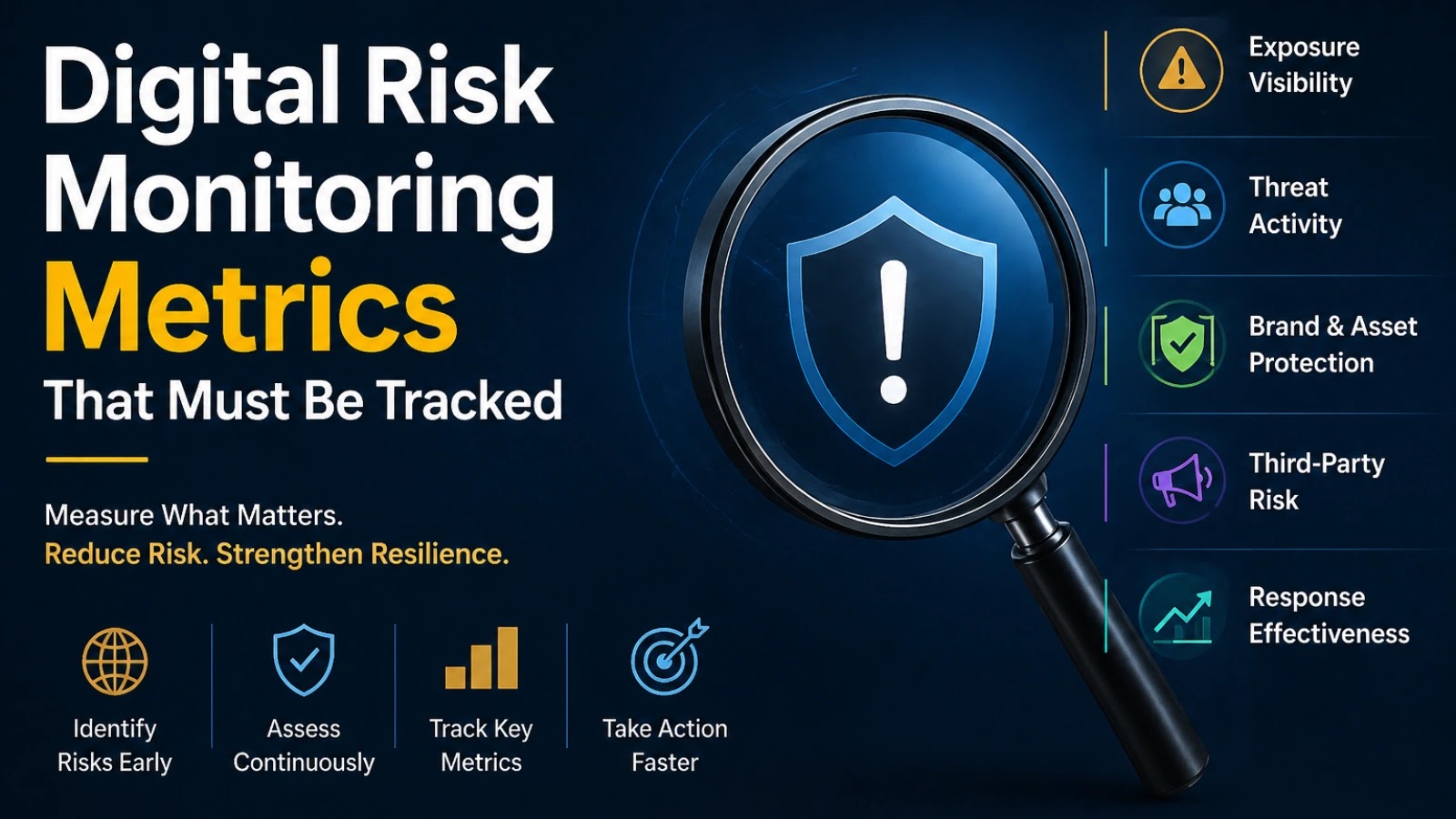
There is a quiet shift in how risk is being understood inside security teams. It is no longer enough to know what exists across the environment. What matters more is how that exposure behaves over time. The numbers being tracked are starting to reflect that change, though not always in a consistent way.
Most CISOs already receive dashboards filled with activity logs, alerts and compliance indicators. The problem sits elsewhere. Many of those figures say little about actual risk movement. They describe noise, not posture.
Digital risk monitoring metrics, when chosen carefully, bring a different kind of clarity. They show direction. They show friction. Occasionally, they show uncomfortable truths that static reports tend to hide.
Why Metrics Need a Reset
There has been a long-standing dependence on operational metrics. Patch counts. Alert volumes. Ticket closures. They are easy to produce and easy to present. They also create a false sense of progress.
A system can be fully patched and still exposed. Alerts can be resolved without reducing risk. Closure rates can rise while attackers move faster than detection teams.
What is often missing is context. Not all vulnerabilities carry equal weight. Not all assets hold equal value. The same applies to external exposure. A leaked credential tied to an inactive account is not the same as one tied to privileged access.
Digital risk monitoring metrics shift attention towards exposure that actually matters. They sit closer to attacker behaviour than internal process efficiency.
The Important Metrics
There is no fixed set that applies to every organisation. That said, some patterns have appeared across mature programmes. These are not theoretical constructs.
They come from environments where risk decisions have consequences beyond reporting cycles. Below are a few of the digital risk monitoring metrics that CISOs should track:
- External Attack Surface Exposure/ Attack surface exposure
This tends to be underestimated until something breaks. Tracking the number of internet-facing assets is not new. What changes the value of this metric is how it is broken down. Unknown assets. Misconfigured services. Shadow infrastructure that sits outside formal inventory.
A growing external footprint without visibility control is rarely accidental. It points to process gaps between development, IT, and security.
More importantly, the rate of change matters more than the total number. A stable attack surface can be managed. A rapidly expanding one often cannot.
- Credential Exposure Rate
Credentials continue to surface in places they should not. Paste sites. Dark web forums. Misconfigured repositories.
What deserves attention is not just the count of exposed credentials, but how quickly they are detected and invalidated. A delay of even a few hours can be enough for automated abuse.
There is also a pattern worth noting. Organisations with strong internal controls still struggle with third-party exposure. Suppliers, contractors, and legacy integrations often widen the gap.
- Time to Risk Remediation
This metric appears in most reports, though it is often diluted. The average time to remediate critical exposures says more than the total number of vulnerabilities discovered. It reflects coordination between teams, prioritisation discipline, and sometimes political friction.
Short remediation windows usually signal alignment. Long ones often reveal dependency chains that no one has fully mapped.
Looking at median and outliers together tells a more honest story than averages alone.
- Threat Actor Interaction Signals/Threat Actor Signals
Not every scan is meaningful. Not every probe deserves escalation.
However, repeated interaction patterns coming from known malicious infrastructure deserve attention. Tracking how often assets are being targeted, and whether those attempts increase over time, adds a behavioural layer to risk monitoring.
This is where digital risk monitoring metrics start to feel closer to intelligence rather than logging.
- Brand and Domain Abuse Indicators/Brand abuse indicators
Impersonation has become very common nowadays. Fake domains, phishing sites, and social media misuse continue to grow in both volume and quality.
Counting these instances has less value unless tied to response timelines. How quickly are takedowns initiated. How often do domains remain active long enough to cause damage.
There is also reputational risk that does not show up in technical dashboards. That tends to surface only after customers notice.
The Uncomfortable Side of Measurement
There is a tendency to select metrics that behave well in reports. Ones that improve steadily or remain predictable.
Digital risk monitoring metrics do not always cooperate in that way. Some of them fluctuate based on external factors. Others expose inconsistencies in internal processes.
This creates tension, especially when metrics start influencing board-level discussions. A spike in credential exposure or external asset growth can raise questions that security teams are not always prepared to answer immediately.
That discomfort is not a flaw. It is the point. Metrics that never create friction are rarely measuring anything meaningful.
Aligning Metrics with Business Reality
One of the repeating issues in security reporting is the disconnect between technical findings and business impact. A vulnerability on a test server is not equal to one on a production payment system. Yet both may appear identical in raw counts.
Digital risk monitoring metrics gain relevance when tied to asset criticality. That requires more than tagging systems. It requires agreement across business units on what truly matters.
There is also the question of tolerance. Some organisations can accept certain levels of exposure due to operational constraints. Others cannot. Metrics without that context risk becoming noise again.
When Tools Start to Shape the Narrative
Many organisations rely on platforms that generate risk scores. These can be useful, though they often abstract away important details.
A single score rarely tells the full story. It hides the underlying factors that contribute to risk. More importantly, it can create a false sense of comparability across environments that behave very differently.
Digital risk monitoring metrics should not be reduced to a single number. They need room to reflect complexity. Tools should support interpretation, not replace it.
The Role of Consistency
Tracking metrics once or twice does not produce insight. Patterns emerge only over time. Consistency in how metrics are defined and measured is important. Small changes in methodology can distort trends. This is particularly true for external exposure metrics where discovery techniques evolve.
There is also a human element. Different teams may interpret the same metric differently. Aligning those interpretations takes effort, and often, iteration. Without that consistency, even well-chosen metrics lose their value.
Where This Leaves CISOs
There is no shortage of data in most environments. The challenge is deciding what deserves attention.
Digital risk monitoring metrics that focus on exposure, behaviour, and response tend to surface the gaps that matter. They do not replace operational metrics, but they sit above them. Closer to decision-making.
They also require a different mindset. One that accepts variability and occasional uncertainty. For many CISOs, the shift is less about adopting new tools and more about asking better questions of the data already available.
Conclusion
Digital risk monitoring metrics that CISOs should track are not about building cleaner dashboards. They are about understanding how risk moves, where it accumulates, and how quickly it can be reduced. The value sits in interpretation rather than collection.
There is also a practical constraint. Building and maintaining this level of visibility takes time, coordination and technical depth that not every organisation can sustain internally. This is where external support becomes relevant.
CyberNX provides cutting-edge software and a team of experts who can give you a full picture of your security, vulnerabilities and risks that come with advanced digital presence. Digital risk does not announce itself politely. Continuous monitoring ensures it does not remain invisible either.