Most teams meet the idea of a cryptographic bill of materials (CBOM) as a compliance requirement or a post-quantum talking point, and then run straight into a practical question that nobody answered for them: where does this thing go? Is it a scanner? An agent on every box? A database? Something that replaces the CMDB, or the certificate manager, or the vulnerability tool already in the stack? The confusion is fair, because a CBOM platform touches a lot of systems, and a tool that touches everything is easy to misplace.
So, it helps to be precise about what a CBOM solution is, where it begins, what it talks to on either side, and where its job stops. Get those boundaries right and integration becomes straightforward.
Get them wrong and you either build an island that nobody feeds, or you buy something that quietly overlaps three tools you already own.
What layer it occupies
Think of a CBOM platform as the system of record for cryptography. That is the cleanest way to place it.
Just as your CMDB is the system of record for assets and your identity provider is the system of record for who can access what, it holds the authoritative record for the keys, certificates, algorithms, protocols, and cryptographic libraries in use across the estate, along with the relationships between them and the applications that depend on them.
That framing already tells you what it is not. It is not a certificate lifecycle manager, though it works alongside one.
It is not a SIEM, though it can feed one. It is not a vulnerability scanner, though it covers a class of risk those scanners miss.
It sits one layer beneath all of them, answering what none of them can alone:
- what cryptography we run,
- where it runs, and
- how exposed it is.
The flow, from ingress to output
The simplest way to understand a CBOM platform is to follow the data as it moves through it. There are three tiers: what feeds it, what it does internally, and what it hands off.
Where it starts: the sources it reads. A CBOM platform does not invent its own view of the estate. It draws the target list from what you already maintain.
In practice, that means pulling from an asset source of truth such as a ServiceNow CMDB, importing a CSV of hosts, or taking a set of IP ranges to work through.
A sensible onboarding step runs a light exploration pass first, finding active hosts and their likely operating systems, and returns that as a report so the security team can choose exactly which systems move forward into a full cryptographic scan.
From there, the actual discovery reaches into the places cryptography lives cloud key management services, HSMs, database encryption, OS and application trust stores, secrets vaults, and application source code.
The collection tier. Discovery runs through a collector paired with a set of sensors. Some sensors are agentless, reaching cloud APIs, KMIP servers, databases, HSMs, and network endpoints without installing anything.
Others are agent-based, for filesystems, source code, and local certificate stores. All of it moves over TLS, and a well-designed collector never holds plaintext secrets, so the act of inventorying does not create a new pile of credentials to protect.
This tier is also where deployment location gets decided: on-premises, in your cloud, hybrid, or delivered as a service, including air-gapped operation where a sensor works from pre-provisioned keys with no outbound call.
The processing tier. Raw discovery output is noisy, so the platform deduplicates it, normalizes it into a single inventory, and correlates each asset back to the applications, services, and data flows that use it.
Then it classifies by type and usage, scores each asset for risk, and flags the quantum-vulnerable cryptography. The result is the CBOM itself: not a flat list, but a deduplicated, risk-ranked, relationship-aware inventory.
Internally, this maps to a handful of functions worth naming, because they show up in most mature platforms: discovery orchestration, inventory management, an analysis and risk engine, identity and access control, and reporting.
Where it ends: the outputs and consumers. This is the boundary people most often get wrong. A CBOM platform produces knowledge and evidence. It is not the thing that rotates a key or patches a library.
Its job ends at a clean, current, exportable inventory and the risk picture attached to it, delivered three ways: dashboards and reports for humans, alerts through channels like email and Teams when something expires or violates policy, and a machine-readable export in an open standard such as CycloneDX for everything downstream.
That export is the handoff point to the rest of the stack.
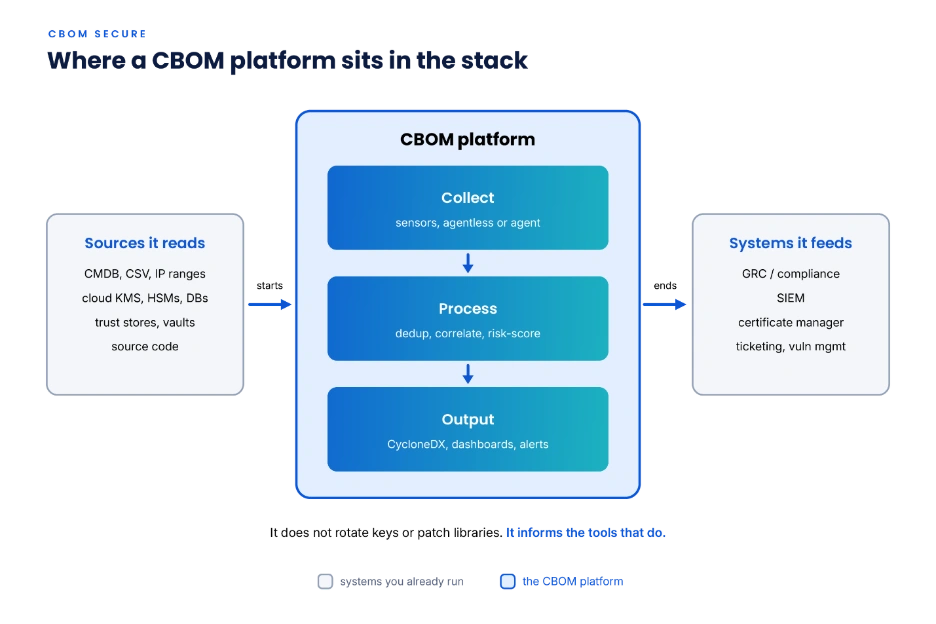
Where a CBOM platform sits: it reads from systems you already run and feeds the ones downstream.
The program around it: a continuous lifecycle
Placing the platform is a static question. Running it is not. An inventory is only useful while it is current, so the platform is really the engine inside a repeating program rather than a tool you point at the network once.
Walking that cycle explains why it must stay wired into the rest of the environment instead of being run and filed away.
It begins before any scanning, with preparation. Someone must own cryptography as a domain; the policies and standards the inventory will be measured against have to be agreed, and the data and systems that matter most must be classified.
Skipping this step is the usual reason later phases produce a heap of findings that nobody acts on.
Discovery and inventory come next, and they are the two the platform is best known for: automated, continuous discovery feeding a single normalized inventory that people can search.
Then analysis and planning, where each asset is evaluated against policy, scored for risk, and turned into a prioritized, dependency-aware plan instead of an undifferentiated backlog.
Remediation and monitoring close it out: changes get made under governance and testing, and the environment is watched for drift, new assets, expiring material, and progress against the plan.
Then it runs again. New systems appear, standards move, keys rotate, and last quarter’s inventory is already out of date, so the program loops back to preparation and repeats.
The value lives in the loop, not in any single pass, which is exactly why a one-time consulting scan and a running platform are not the same thing.

The lifecycle is continuous: prepare, discover, inventory, analyze, prioritize, remediate, monitor, then iterate.
Drawing the boundaries with adjacent systems
The reason the “where does it end” question matters is that a CBOM platform lives among tools that look adjacent. Being explicit about the seams keeps you from buying overlap.
Against the CMDB, the relationship is consumer, not replacement. It reads the asset list from the CMDB to know what to scan, and can enrich it with cryptographic context, but the CMDB remains the asset system of record.
Against a certificate lifecycle manager, the two are complementary and often paired. It discovers certificates as one asset class among many and can pass findings to the certificate manager, which owns issuance, renewal, and revocation.
Encryption Consulting’s own certificate lifecycle management tool, CertSecure Manager, integrates natively for exactly this reason, but the principle holds for any certificate tool.
Against a SIEM or SOAR, it is a source, not a peer. It emits events and evidence that a SIEM can ingest, but correlation of security events across the enterprise stays with the SIEM.
Against vulnerability management, it covers a blind spot rather than duplicating coverage. Traditional scanners find missing patches and known CVEs; the CBOM finds weak algorithms, reused keys, and quantum-exposed cryptography that those scanners were never built to see.
Against GRC and compliance platforms, it is the evidence supplier. It produces the current, policy-evaluated inventory that an auditor or a GRC tool needs, so compliance reporting stops being a manual reconstruction every cycle.
Against a secrets manager, it integrates rather than competes. It should pull credentials from the vault you already run at the moment of use, not become a second store of every secret in the company.
Making it compatible: the integration design that matters
Once the boundaries are clear, compatibility comes down to a few properties worth checking before anything is signed.
The most important is open output. If the inventory only lives inside the vendor’s console, it cannot feed your GRC tool, your SIEM, or your ticketing system.
Exporting the CBOM in CycloneDX format, a standard the software bill of materials ecosystem already uses, keeps the inventory portable and keeps you out of a lock-in.
Next is reach without disruption. Agentless collection for systems where you cannot or will not install software, agent-based collection where you need depth, and metadata-only extraction from sensitive systems such as HSMs and databases so private key material is never touched.
A platform that forces one deployment style onto mixed infrastructure will leave gaps.
Then deployment flexibility, so the platform can sit wherever your architecture and data-residency rules require, including air-gapped enclaves.
An API and a plugin model matter too, so new or proprietary sources can be added without waiting on the vendor, and so the CBOM can push into whatever ticketing or orchestration you use.
And because large organizations are rarely one tenant, isolation between business units, subsidiaries, or managed clients on a single deployment is what keeps one platform from becoming many.
Finally, identity. The platform should slot into your existing access model with role-based control and single sign-on, so the cryptographic system of record is governed the same way the rest of your systems are.
The short version
A CBOM platform sits below your certificate manager, your SIEM, your GRC tool, and your vulnerability scanner, and it feeds all of them.
It starts by reading your existing asset sources, reaches across every layer where cryptography hides, and ends at a deduplicated, risk-scored, relationship-aware inventory exported in an open standard.
It does not rotate keys, patch libraries, or run your compliance program. It gives every one of those functions the accurate cryptographic picture they have been missing and then gets out of their way.
How CBOM Secure maps to this architecture
That is the shape CBOM Secure from Encryption Consulting is built to. It reads from the sources you already run, discovers across every layer where cryptography hides, and exports a CBOM in CycloneDX 1.6 and 1.7 that plugs into the rest of the stack. Concretely, here is how it delivers each of the capabilities described above:
- Reading from your sources. Rather than inventing its own view of the estate, it works from asset lists you already maintain, a set of IP ranges, or an imported host file, and it opens with a light exploration pass so your security team promotes only the systems it chooses into a full cryptographic scan.
- Multi-layer discovery. Nineteen production sensors reach cloud KMS on AWS, Azure, and GCP, HSMs over PKCS#11, KMIP servers, MSSQL, MySQL, and Oracle database encryption, application source code across seven languages, Windows and OS trust stores, GPG keyrings, HashiCorp Vault, TLS endpoints, Active Directory, and LDAP, using both agentless and agent-based collection.
- Touching nothing it should not. HSM and database sensors extract key metadata only, so private key material is never read, and the collector never holds plaintext secrets.
- One clean inventory. Discovery output is deduplicated, normalized, correlated back to the applications that depend on it, scored for risk from 0 to 100, and tagged wherever cryptography is quantum-vulnerable.
- Outputs the rest of the stack can use. Role-based dashboards and reports for people, expiry and policy-violation alerts over email and Microsoft Teams, and a machine-readable CycloneDX export that feeds your GRC, SIEM, and ticketing tools without lock-in.
- Living beside your other tools. It consumes the CMDB rather than replacing it, pairs natively with CertSecure Manager for certificate lifecycle, feeds a SIEM as a source, supplies audit-ready evidence to GRC, and pulls credentials from a vault such as HashiCorp Vault instead of becoming a second secrets store.
- Deploying where your rules require. On-premises, in your cloud, hybrid, or as a service, including air-gapped operation, with a plugin model for new sources, full isolation between business units on a single deployment, and role-based access with single sign-on.
If you are trying to place a CBOM in your own architecture, start by mapping those two seams: the sources it will read and the systems it will feed, and the rest of the design tends to fall into place.